
An infinity edge pool in Florida creates the appearance of water extending into the surrounding landscape by allowing it to flow over a lowered pool wall into a concealed collection system. Also called a vanishing edge pool or negative edge pool, this design requires specialized engineering, drainage planning and additional circulation components. Infinity edge pools can be built on flat or sloped Florida properties, although site conditions, structural requirements and custom features influence the final cost.
For homeowners throughout North and Central Florida, an infinity edge pool can create a striking visual connection between the swimming pool and a lake, wooded preserve or open landscape. Understanding the design, construction requirements and costs helps determine whether this feature is appropriate for your backyard.
Quick Answer
Can you build an infinity edge pool in Florida? Yes. An infinity edge pool can be designed for flat or sloped properties by incorporating a lowered overflow wall, collection basin and properly engineered circulation system. National cost estimates commonly range from $65,000 to $150,000, although custom Florida projects may fall outside that range depending on the property, engineering and finishes. A site-specific design and estimate are necessary before construction.
How an Infinity Edge Pool Works
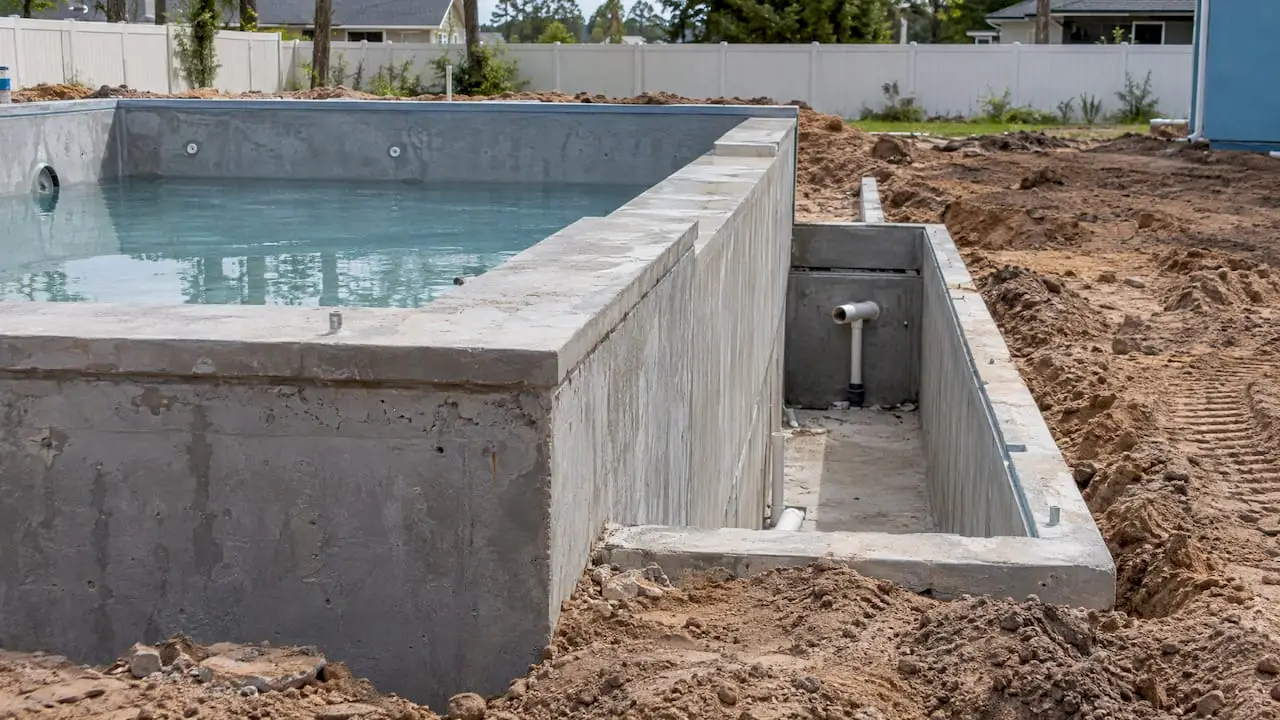
An infinity edge pool uses a precisely leveled wall, called a weir, to create a continuous sheet of water flowing into a concealed catch basin. The collected water returns through an engineered circulation system, creating the illusion that the pool extends into the surrounding view. Unlike conventional swimming pools, infinity edge pool construction requires additional water collection capacity, plumbing and water-level controls.
The position and dimensions of the overflow edge are essential to achieving a consistent appearance. As explained in AQUA Magazine’s infinity edge pool construction guide, the collection system must capture water spilling over the wall while remaining hidden from the primary viewing area. Surge capacity must also accommodate changes in water level when swimmers enter and exit the pool. Proper engineering helps maintain consistent overflow and reliable circulation.
Vanishing Edge vs. Negative Edge vs. Zero Edge
If you have been reading several pool websites, the vocabulary can seem inconsistent. Here is how the terms line up in practice:
-
Infinity edge, vanishing edge, negative edge: the same lowered-wall overflow, as described in a commercial pool guide. Different regions and builders favor different names.
-
Zero edge: water sits flush with the surrounding deck and overflows into a perimeter gutter. It looks like a glass sheet, but there is no hidden wall and no drop-off.
-
Beach entry: not an overflow design at all, but a sloping, shallow entrance. Many Florida families pair that with a raised infinity edge elsewhere in the pool, and our beach entry pool guide shows how that works.
One practical note on viewing: the illusion works only from certain angles. Standing in the pool at the edge, you see the view. Looking up from below the weir, you see the wall and the catch basin. The design should place the pool and the seating so the best view faces the people using them.
Infinity Edge vs. Traditional Pool
| Feature | Infinity Edge Pool | Traditional Pool |
|---|---|---|
| Water movement | Overflow spills over a lowered wall, then is pumped back | Skimmers pull surface water, jets return it |
| Extra components | Catch basin, surge chamber, dedicated edge pump | Standard pump, filter and skimmers |
| Engineering | Structural design for the raised wall, drainage and basin | Standard structural design |
| Best site | Elevated, sloped or view-facing lots, or designs with a built-up edge | Almost any yard |
| Typical U.S. cost | Average near $95,000 (Angi), $98,000 (Fixr) | Lower; depends on size and finishes |
| Water and upkeep | More water in the system and a second pump to maintain | Simpler circulation |
| Look | Water appears to merge with the horizon | Visible coping and tile line |
Neither is better in every case. If your backyard faces a pond, golf course, wooded preserve or open sky, the infinity edge makes sense. If the main goal is swimming laps, a spa and a shaded lanai, a conventional pool built well often serves you better per dollar. Our pool design ideas for Florida homes cover that range of styles.
Where an Infinity Edge Works Best
The classic setting is a hillside, where the pool sits at the top of a slope and the edge faces the drop. Water spills toward a view and the lower terrain hides the basin. Florida rarely offers that kind of grade, so we think about the question differently.
Backyards With a Natural View
The edge should face something worth looking at: a lake, a retention pond, a tree line, a fairway or the Intracoastal. Facing a neighbor’s fence wastes the effect. In places like Ocala and Marion County, horse country and open pasture can supply the sightline, while in Daytona Beach, Palm Coast and St. Johns County, water views are the draw.
Flat and Gently Sloped Lots
On a flat lot, the pool is raised so the edge wall stands above the surrounding grade. The basin sits behind and below it, often within the raised structure or in a landscaped trench. A modest slope helps: it can reduce how much earth must be built up. A site survey sets the real options, and the design stage is where we check them.
Edge Direction and Sun
An edge facing west or southwest catches the sunset but also afternoon glare, which can wash out the visual effect. Think about when you swim and entertain, then orient the edge accordingly.
Design and Construction Requirements
The build differs from a conventional pool in several ways you should plan for.
-
Structural engineering. A raised or cantilevered wall holds water pressure on one side and is exposed on the other. It needs engineered drawings, usually reviewed with soil data.
-
Catch basin. Built to hold overflow during heavy use and sealed so it does not leak into the ground.
-
Surge or balance tank. Sized to absorb level swings when swimmers enter and exit.
-
Overflow circulation and plumbing. The infinity edge requires an engineered collection and return system, with pumping equipment and controls selected according to the pool’s design and circulation requirements.
-
Precise leveling. The weir must be level along its full length, or the water sheet runs thick in one spot and thin in another.
-
Automation. Float controls and valves keep levels steady. Our pool automation and lighting work covers that control layer.
Construction timelines for infinity edge pools depend on structural engineering, permitting, site preparation and the complexity of the overflow system. Our stage-by-stage Florida pool timeline explains the major phases of custom pool construction.
Florida-Specific Considerations
Soil, Groundwater and Drainage
A Florida lot’s soil and groundwater levels vary from block to block, and a raised pool with a basin is more sensitive to them than a standard one. Soil conditions affect footing design, excavation, and whether the basin and tank need extra protection from groundwater pressure. That is why we want site data before any final pricing, not after. Heavy summer rain and tropical storms also put water into the catch basin and the yard, so overflow and storm drainage need to be designed together, with the pool’s water level controlled during storms.
Engineering and Permitting
Building an infinity edge pool in Florida requires coordination of structural engineering, excavation, plumbing, electrical systems and drainage. Depending on the property and jurisdiction, permit applications may require engineered construction drawings, site plans and additional documentation addressing soil conditions, retaining structures or elevated pool walls.
Florida pool construction must comply with applicable state building requirements and local permitting procedures. The Pool & Hot Tub Alliance provides information about the International Swimming Pool and Spa Code, which jurisdictions may adopt or amend. Homeowners in Marion, Volusia, St. Johns, Duval and Leon counties should confirm requirements with the appropriate local building department. Permit fees and approval timelines vary according to project complexity and jurisdiction.
Safety Barriers
An infinity edge pool in Florida must comply with applicable residential swimming pool safety requirements. Under Florida’s Residential Swimming Pool Safety Act, qualifying residential pools must meet prescribed safety-feature requirements, which may include approved barriers, safety covers, door and window alarms or other qualifying protections. Applicable building-code provisions must also be considered during design.
Infinity edge features do not replace required pool safety measures. Raised walls, overflow channels and changes in elevation should be evaluated carefully, particularly where children may access the pool area. Federal suction-outlet safety requirements also apply where relevant to the pool’s circulation design. Our Florida pool fence requirements guide explains important considerations involving barrier heights, gates and residential pool safety.
What an Infinity Edge Pool Costs
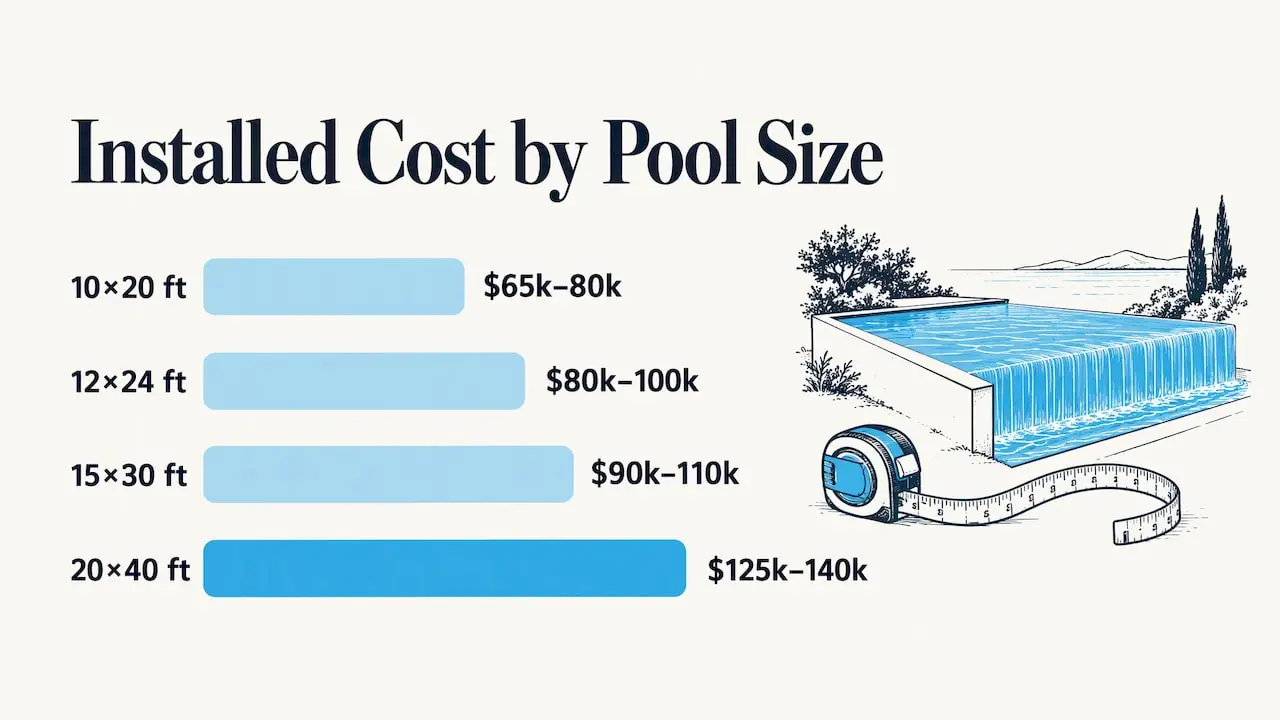
The cost of an infinity edge pool in Florida depends on pool size, structural engineering, site elevation, finish materials, overflow-system design and surrounding outdoor features. Published national estimates provide a useful starting point, but they should not be treated as fixed Florida construction prices.
According to Angi’s infinity pool cost guide, the national average is approximately $95,000, with many projects ranging from $65,000 to $150,000. Fixr’s infinity pool pricing guide reports a national average near $98,000, with its typical range of $90,000 to $105,000. These estimates use different project assumptions, and customized pools may cost considerably more.
Additional expenses can include reinforced catch basins, retaining structures, specialized tile or stone, dedicated circulation equipment, drainage improvements and landscaping. The design should also account for ongoing maintenance of the overflow system. For regional budgeting, see our Daytona Beach inground pool cost guide and what a $100,000 pool can include in Florida.
Maintenance and Water Circulation
Because water moves through two circuits, a few habits keep an infinity edge looking right:
-
Keep the weir clean. Debris and scale on the edge cause uneven flow. Brush and rinse it as part of the regular routine.
-
Watch the water level. The surge system depends on a stable level. Too low and the sheet breaks, too high and the basin overworks.
-
Check the basin and tank. Leaves and silt collect where you cannot see them.
-
Balance chemistry for the whole system. The extra water in the tank and basin is part of the chemistry, and Florida sun and heat speed sanitizer use.
-
Service the circulation equipment. Each one needs its own checks.
Built-in automation makes this easier, and the equipment we install and supply, from pumps and filters to sanitization and LED lighting, is chosen to suit each system.
Agua Pools’ Approach to Infinity Edge Pool Design
At Agua Pools, infinity edge pool design begins with the property, the available view and the homeowner’s outdoor living goals. Our team coordinates structural planning, plumbing, water features and finishing details to create a cohesive pool environment. Each design considers how the overflow edge will appear from the patio, seating areas and surrounding landscape.
Through our 3D design process, homeowners can visualize the waterline, overflow wall and surrounding deck before construction begins. Infinity edge designs can also incorporate integrated spas, landscape lighting and outdoor living features that complement the finished backyard.
Plan Your Infinity Edge With Agua Pools
Agua Pools designs and builds custom swimming pools, spas and outdoor living spaces throughout North and Central Florida. Contact our team to discuss your property, design goals and budget, or explore our custom pool design process and new pool construction to learn more.
Frequently Asked Questions
Is a Vanishing Edge Pool the Same as an Infinity Pool?
In most cases, yes. Vanishing edge, negative edge and infinity edge all describe a pool whose wall is lowered so water spills into a hidden basin. A zero edge pool is a different design, where water sits flush with the deck and overflows into a gutter.
Can You Build an Infinity Edge Pool on a Flat Lot?
Yes. The pool is raised or the edge wall is built up so that the water drops into a basin on the far side. A site survey and engineering review tell us how much structure the lot needs, and the 3D design shows how the finished edge will look.
How Much Does a Negative Edge Pool Cost?
U.S. guides report averages of about $95,000 to $98,000, with most projects between $65,000 and $150,000 (Angi). The final price depends on size, materials, engineering and site conditions, so a design review is the only way to get a number for your yard.
Do Infinity Edge Pools Need Special Permits in Florida?
They go through the same local permit process as other pools, typically covering building, electrical and plumbing, but the structural and soil drawings are more detailed. Your county or city building department confirms what applies, and we prepare the permit set as part of the build.