
Florida law requires a residential pool barrier at least 4 feet high on the outside, with no gaps a young child could crawl under, squeeze through or climb over, and with a gate that opens outward and closes and latches on its own. A fence is not the only way to comply, though. Under the state’s Residential Swimming Pool Safety Act, a new pool must have at least one of five listed safety features to pass final inspection. Your county or city building department decides how those rules are applied on your lot.
This guide walks through what Florida Statutes 515.29 and 515.27 actually say, how gates and alternatives work, and where local codes in North and Central Florida can add detail.
What to Know: Quick Answer
-
The barrier must be at least 4 feet (48 inches) high measured on the outside, and it cannot have gaps, openings, indentations, protrusions or structural parts a young child could use to get through or over.
-
Gates must open outward, away from the pool, close by themselves and latch by themselves, with the release on the pool side, out of a young child’s reach.
-
A fence is one path, not the only one: Chapter 515 lets a new pool pass inspection with at least one of five safety features, including an isolation barrier, an approved safety cover, door alarms, self-latching doors or a pool alarm.
-
A screen enclosure, dwelling wall, or combination of approved barriers may qualify when all applicable requirements are met. A dwelling wall used as part of the barrier cannot have doors or windows that open to provide pool access.
-
Permits and inspections run through your local building department, so confirm details in Marion, Volusia, St. Johns, Duval, Flagler, or Leon County before you order materials.
What Florida Law Means by a Pool Barrier
Most homeowners picture a metal or aluminum fence. The statute is broader. Chapter 515 defines a barrier as a fence, a dwelling wall, a nondwelling wall, or any combination of these that completely surrounds the swimming pool and obstructs access to it, especially access from the house or from the yard.
That definition matters when planning a backyard pool. Under Florida Statute 515.29, a dwelling wall may serve as part of the pool barrier only if it has no door or window that opens to provide pool access. Screen enclosures and other approved barriers must also meet applicable safety requirements. Homeowners should confirm their proposed barrier layout with the local building department before construction.
The law applies to residential swimming pools. Public and commercial pools fall under a separate set of rules from the Florida Department of Health, so this article covers only private, single-family and similar residential pools.
Florida Pool Fence Height and Design Rules
Section 515.29 sets the physical characteristics. Here is what the 2026 text requires.
| Requirement | What the statute says |
|---|---|
| Height | At least 4 feet high on the outside |
| Openings | No gaps, openings, indentations, protrusions or structural components that could let a young child crawl under, squeeze through or climb over |
| Placement | Around the perimeter of the pool, separate from the yard fence unless that fence is on the pool’s perimeter, is used as part of the barrier and meets the same requirements |
| Distance from water | Far enough from the water’s edge that a child who gets past the barrier does not fall straight into the pool |
| Gates | Open outward, self-closing, self-latching, release on the pool side and out of a young child’s reach |
Why Outside Height Is the Measurement That Counts
The 4 feet is measured on the outside, the side a child approaches from, not from the pool deck. If your yard slopes or you add planters, raised beds or a retaining wall next to the fence, the outside height can shrink. A fence that measures 48 inches from the pool deck may measure less from the lawn. Check the lowest outside grade along the whole run.
Gaps, Climbable Features and Spacing
The statute is performance-based: it does not publish one picket spacing in the section text. Instead, it bars any gap or feature a young child could use. In practice, that rules out horizontal rails that work like ladder rungs on the outside, decorative cutouts and wide gaps at the bottom of the fence on uneven ground. Inspectors apply the building code details, so ask your building department for the current spacing and clearance limits before you choose a style.
Furniture, grills and planters placed near the barrier can turn a compliant fence into a climbable one. Keep them away from the outside face.
Setback From the Water
The law says the barrier must sit sufficiently away from the water’s edge. It leaves the exact distance to the building code and the local inspector, so confirm the number with your permitting office during plan review. This is why a fence installed tight against the coping often fails. Plan the fence line during pool design, not after.
Gate Requirements for Florida Pool Barriers
The gate is where most barriers fail. Under Section 515.29, any gate that gives access to the pool must meet four conditions:
-
It opens outward, away from the pool.
-
It closes by itself.
-
It latches by itself.
-
The latch release sits on the pool side of the gate, placed so a young child cannot reach it over the top or through any opening or gap.
Florida’s residential building code includes additional gate-latch requirements. Under Section R4501.17.1.8, a release mechanism positioned at least 54 inches above the bottom of the gate may be located on either side when the specified safety conditions are met. The code also restricts openings near the release mechanism to prevent children from reaching the latch. Homeowners should confirm the appropriate gate hardware and placement with their local building department.
Two practical points. First, test the gate from a fully open position. Hinges settle over time, and a gate that closed perfectly on inspection day can drag in Florida’s humidity. Second, choose hardware rated for outdoor and salt-air conditions, especially near the coast in Daytona Beach, Palm Coast or St. Johns County, where corrosion stops latches from catching.
The Five Safety Feature Options in Section 515.27
Here is the part that surprises many homeowners. Section 515.27 says that to pass final inspection and receive a certificate of completion, a residential pool must meet at least one of five requirements:
-
An isolation barrier: the pool is isolated from access to the home by a barrier that meets Section 515.29.
-
A safety pool cover: a cover that meets ASTM F1346.
-
Exit alarms: alarms on all doors and windows with direct access to the pool, sounding at 85 dBA at 10 feet.
-
Self-closing, self-latching doors: all doors with direct access from the home to the pool, with a release mechanism no lower than 54 inches above the floor.
-
A pool alarm: a device that sounds when it detects an accidental or unauthorized entry into the water, certified to ASTM F2208 according to the state’s list.
Florida law identifies several residential pool safety options, but homeowners must also comply with applicable Florida Building Code provisions and local permitting requirements. Before selecting a fence, safety cover, alarm, or other protective feature, confirm the requirements with the building department responsible for your property.
Penalties and the Grace Period
Under Florida Statute 515.27, failing to equip a new residential pool with a required safety feature can result in a second-degree misdemeanor. The statute provides an exception to the penalty when the required safety feature is installed within 45 days after arrest, summons, or notice to appear, and the person completes the required drowning prevention education program. The education requirement may be waived if the program is unavailable within the specified period.
Approved Alternatives to a Standard Fence
A conventional aluminum or glass fence is the most common choice. These alternatives also work in the right setup.
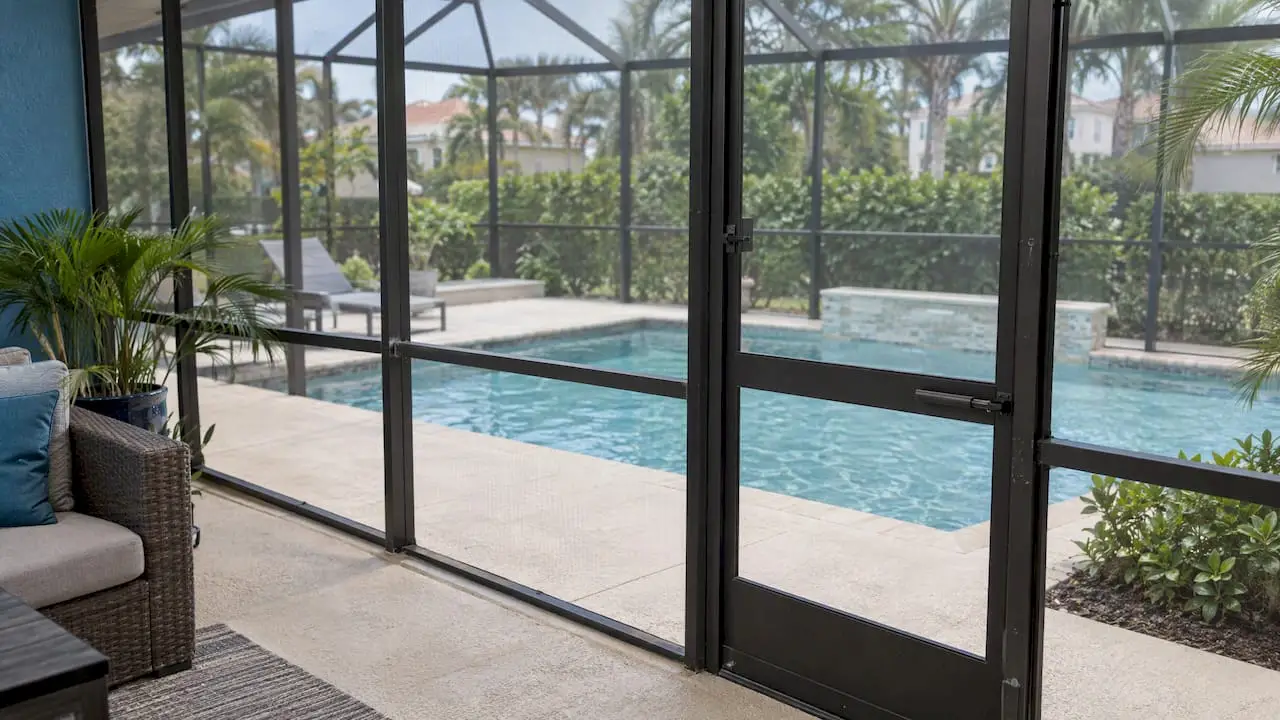
Screen Enclosures
A properly designed screen enclosure may serve as part of a compliant residential pool barrier when it meets applicable Florida Building Code requirements. Enclosure doors, access points, and protective hardware must also satisfy the relevant safety standards. Homeowners considering pool screen enclosures should confirm barrier compliance during the permitting and design process.
Mesh Removable Fencing
Removable mesh pool fencing provides a flexible safety barrier for Florida homeowners. To qualify, the fencing must meet applicable Florida Building Code requirements, including proper height, secure anchoring, and compliant gate hardware. Not all removable mesh fencing products meet these standards, so homeowners should verify product specifications and installation requirements with their local building department before purchasing.
Safety Covers, Alarms and Door Hardware
Under Florida Statute 515.27, qualifying pool safety features include approved safety covers, door and window exit alarms, and self-closing, self-latching doors. Each option must meet applicable safety requirements and building codes. Pool covers and alarms provide additional protection but never replace responsible adult supervision.
Above-Ground Pools
The statute lets the structure of an above-ground pool act as its barrier, or a barrier can be mounted on top of it, as long as the structure or mounted barrier meets all of Section 515.29. Ladders and steps need their own protection when they are not removed.
Local Codes in North and Central Florida
Florida’s Residential Swimming Pool Safety Act establishes statewide pool safety requirements, while the Florida Building Code, adopted under Section 553.73, provides additional technical standards. Local building departments oversee permits, plan reviews, and inspections. Requirements may vary by jurisdiction, so homeowners should confirm applicable rules before construction.
| Area | What to do |
|---|---|
| Marion County and Ocala | Ask the county or city building department which one issues your pool permit, and what barrier drawings they want |
| Volusia County, Daytona Beach and Daytona Beach Shores | Confirm the permit office for your address and any coastal or flood-zone limits on fence footings |
| St. Johns County and St. Augustine area | Check whether an HOA or architectural review also applies |
| Duval County and Jacksonville | Confirm permit submission requirements before fence drawings are finalized |
| Leon County and Tallahassee | Check the city or county office for your parcel and its inspection sequence |
| Palm Coast | Confirm the city permit rules and any canal or lakefront barrier questions |
Waterfront lots raise a frequent question. A pool on a canal, lake or bay still needs a compliant barrier around the pool itself, since the statute focuses on access to the swimming pool. Seawalls and open water do not count automatically. Raise it during plan review.
HOAs can be stricter about appearance. A fence can meet the statute and still fail an HOA review for color, height of landscaping or material. Get the HOA approval in writing before the permit is filed.
Planning a Fence With Your Pool, Not After It
The cleanest compliance happens when the barrier is designed with the pool. That decides where the gate goes, how far the fence sits from the water and whether the lanai doubles as the barrier. In a custom pool design process, the layout is drawn in 3D first, so you can see the fence line, the gate swing and the deck before anything is dug.
The same logic applies to a remodel. If you are resurfacing or redoing the deck, a pool remodeling project is the moment to fix a gate that swings the wrong way, a fence that sits too close to the coping or a barrier with climbable rails.
Our Perspective on Layered Pool Safety
Pool safety begins during the design process. Gate placement, barrier height, access from the home, and surrounding landscaping should all be considered before construction begins. Planning these details early helps homeowners address safety requirements without making unnecessary changes later.
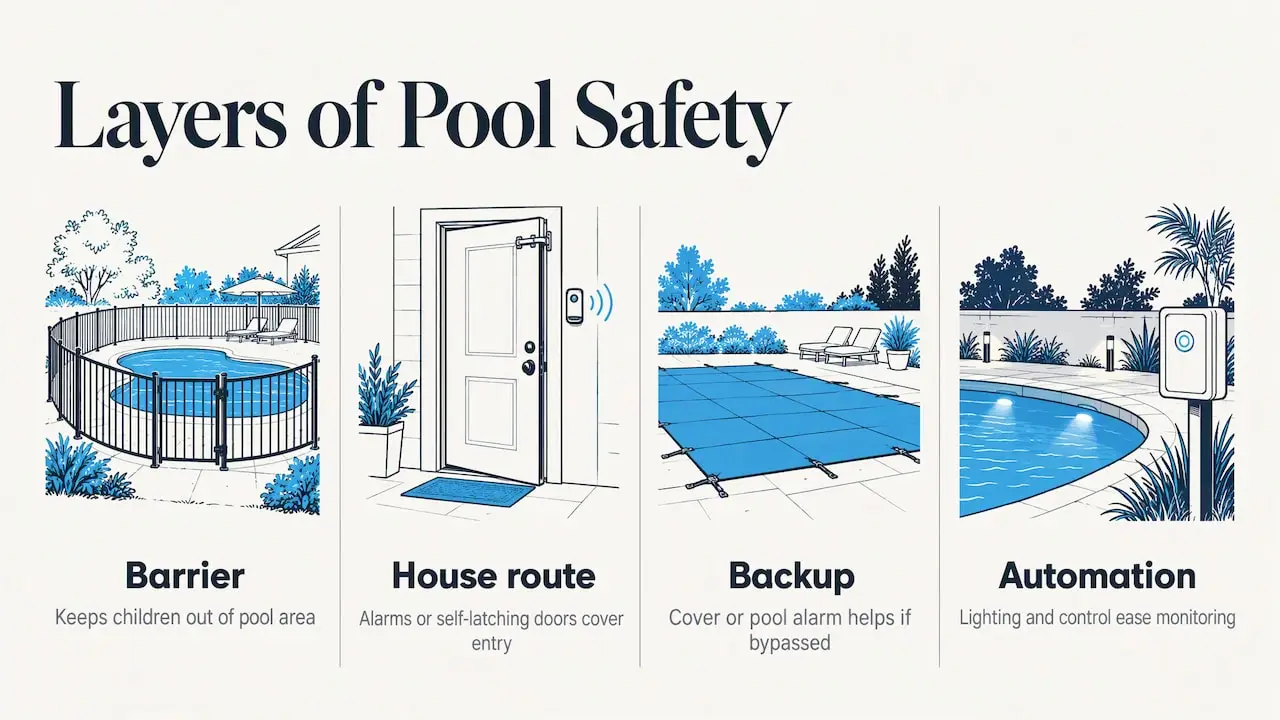
Although Florida’s Residential Swimming Pool Safety Act identifies several qualifying safety features, homeowners must also satisfy applicable building codes and local inspection requirements. Combining compliant barriers with alarms, appropriate door hardware, and adult supervision can provide additional layers of protection.
For homeowners across North and Central Florida, Agua Pools incorporates pool layout, decking, access points, and outdoor living features into the design process. This helps coordinate safety planning with the overall pool project.
Build Pool Safety Into Your New Pool Design
Planning a new swimming pool involves more than choosing its shape and finish. Barrier placement, access points, decking, and surrounding outdoor features should be considered early to help accommodate applicable safety requirements.
Agua Pools provides new pool construction and custom design services throughout North and Central Florida. Explore our pool automation and LED lighting options and browse the Florida pool gallery for design inspiration.
Pool Fence FAQs
How High Must a Pool Fence Be in Florida?
At least 4 feet (48 inches) on the outside, according to Section 515.29. It also cannot have gaps, openings, indentations, protrusions or structural parts that would let a young child crawl under, squeeze through or climb over.
Do I Legally Need a Fence Around My Pool?
Not necessarily a fence. A new residential pool must meet at least one of five safety options under Section 515.27 to pass final inspection. A fence or other compliant barrier is one option, alongside a safety cover, door alarms, self-latching doors or a pool alarm. Your local building department may require specific items, so confirm before you build.
Can a Screen Enclosure Serve as the Pool Barrier?
Yes, it can. Chapter 515 counts a non-dwelling wall as part of a barrier, and a screen enclosure is generally treated that way if it completely surrounds the pool and meets code. The enclosure door must also self-close and self-latch.
How Should a Pool Gate Work?
It must open outward, away from the pool, close automatically, and latch automatically. Florida’s residential building code includes specific requirements for latch placement, release mechanisms, and openings near the latch. Homeowners should confirm the appropriate gate hardware with their local building department.
Talk to Agua Pools About Your Florida Pool
Whether you’re planning a pool in Ocala, Daytona Beach, Palm Coast, St. Augustine, Jacksonville, Tallahassee, Holly Hill, or surrounding North and Central Florida communities, Agua Pools can help you design a swimming pool that complements your backyard while considering applicable safety requirements. Contact Agua Pools to get started.