
The best outdoor shower ideas start with how you will use the shower, not how it will look. A quick rinse station beside the pool needs a different footprint, valve and floor than a private, hot-and-cold enclosure you use daily. Pick the use, then the style, the privacy screen, the materials and the drainage. In Florida, where the pool is part of daily life, a well-placed shower also keeps sand, sunscreen and chlorine out of your house.
Before You Get Started
-
Decide between a simple rinse station and a full enclosure before you choose any finishes. The footprint, plumbing and drainage follow from that choice.
-
Place a poolside shower on the path between the pool and the back door, with slip-resistant flooring and hooks or a shelf within reach.
-
Privacy comes from walls, fencing, planting or placement. Each has tradeoffs in cost, airflow and upkeep.
-
Plan drainage away from the house, and ask your local building department which plumbing and electrical rules apply before work starts.
-
Choose corrosion-resistant fixtures. Coastal and humid Florida air is hard on cheap hardware.
Decide What Kind of Outdoor Shower You Need
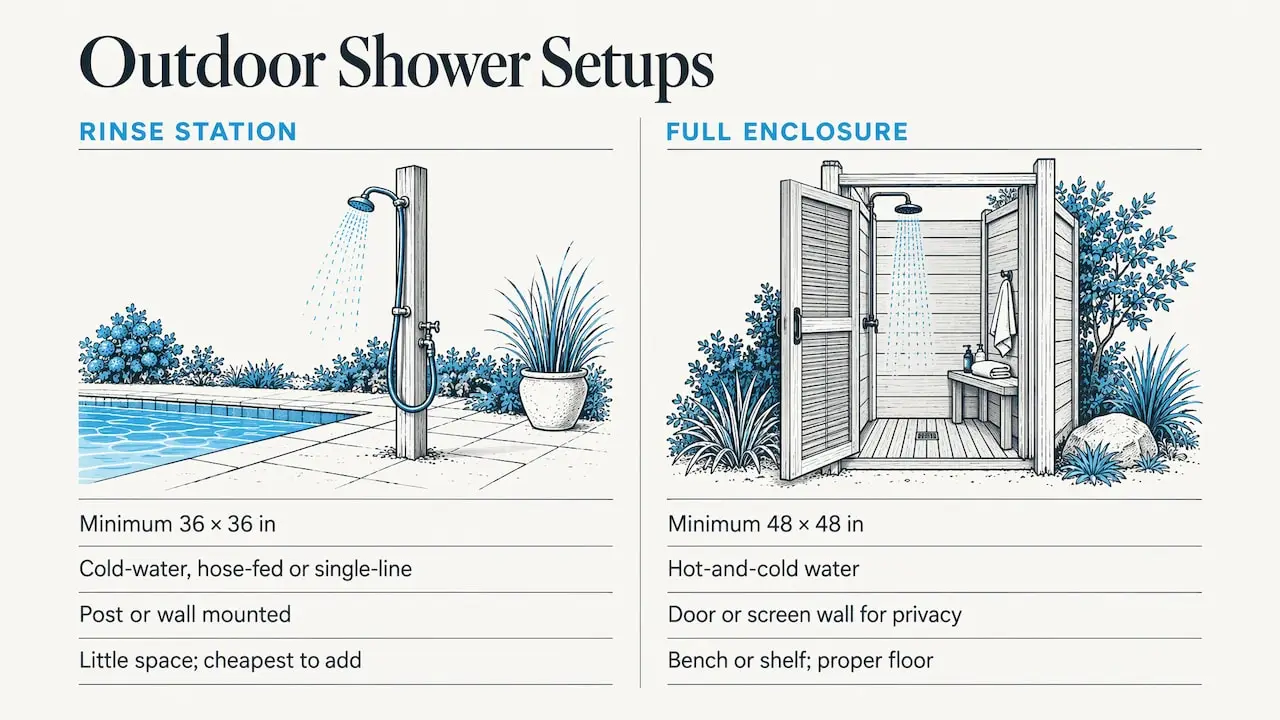
Two setups cover most backyards.
A rinse station. This is a cold-water, hose-fed or single-line shower on a post or wall. It suits pool decks, dog washing and a quick sand rinse. It needs little space and is the cheapest to add.
A full enclosure. This is a permanent shower with hot and cold water, a door or screen wall, a bench or shelf and a proper floor. It feels like a bathroom with a sky ceiling, and it is the one people use for a real shower after a day on the water.
Lowe’s guidance on outdoor showers frames it the same way: decide on pool proximity, temperature expectations, storage and guest capacity first, then pick the shower type. Hold that order. Buyers who start with a rain head they saw online often find the layout will not drain or will not fit.
Size matters too. A flooring company’s design guide suggests at least 36 by 36 inches for a rinse station and 48 by 48 inches for an enclosure with room to change, with towel hooks, a shelf and a foot-rinse spigot. Those are useful minimums to sketch against.
Outdoor Shower Design Ideas by Backyard Style
A shower looks best when it belongs to its surroundings. The Spruce’s landscape perspective is to tie the shower to its setting with paths, planting, walls and materials instead of treating it as a loose fixture. Here is how that plays out in styles common across North and Central Florida.
Resort-Style Spa Courtyard
A stone-walled courtyard with a gravel path reads as a spa. The Spruce points to this look for larger yards, where high walls or fencing add privacy. Pair a rain head with a handheld spray, a niche for soap and a pebble or stone floor. This fits a pool with a spa, a pergola and soft lighting.
Natural Wood and Greenery
Cedar or similar slats with tropical planting make a shower that disappears into the landscape. It suits a wooded Ocala lot or a yard with mature oaks. Wood needs periodic treatment against mildew and fading in humid weather, so budget a yearly seal.
Matching the House
Architectural Digest highlights repeating stone or other materials from the house in the shower enclosure so the shower feels like part of the architecture. On a stucco or stone Florida home, that might mean the same paver, tile or coping used around the pool. Our guide to pool design ideas for Florida homes shows how to keep those finishes consistent across the whole yard.
Indoor-Outdoor Shower
Some of the most appealing showers sit in courtyards, on balconies or in indoor-outdoor rooms. Architectural Digest notes that an indoor-outdoor shower with a wall of windows can be used year-round in any climate. Off a pool bath or a lanai, this works especially well and keeps plumbing close to the house.
Planting Around the Shower
Greenery softens hard edges and provides natural privacy for an outdoor shower. For Florida backyards, consider plants that tolerate humidity, occasional water exposure and the amount of sunlight the area receives. Position larger shrubs and trees away from plumbing and drainage components, and leave enough space for maintenance and airflow. Our guide to pool privacy ideas for Florida backyards offers additional ways to combine landscaping, screening and outdoor living features.
Poolside Outdoor Shower Ideas
A poolside shower earns its place every day. The goal is to get swimmers rinsed before they hop in and again before they head inside.
Place it on the traffic path. Put it between the pool and the door people actually use. A shower tucked at the far corner of the yard gets ignored.
Choose the right setup. Lowe’s suggests a hose-fed station for a simple setup, or a permanent pool-house shower with hot and cold water and an enclosure. The same guidance recommends slip-resistant tile, hooks or shelves, and multiple heads or stalls if you host often.
Mind the floor. Wet feet and pool decks meet here. Choose a textured, slip-resistant surface, and think about heat. A dark paver baking in July is no fun barefoot. Our cool deck options for Florida pools page compares surfaces that stay comfortable underfoot.
Add a foot rinse. A low spigot at the base keeps sand and grass off the deck and out of the house.
Plan the lighting and power. If you want illuminated niches, a timer or other electrical features, include them in the design before construction begins. Electrical installations near pools and outdoor showers require appropriate protection and compliance with applicable Florida electrical codes. Have a licensed electrician evaluate the installation and confirm local requirements.
Think about the whole pool plan. When a shower is part of a new build, it is easier to run supply and drain lines during construction than to cut into a finished deck. We cover the sequence in our pool construction timeline for Florida.
Privacy for an Outdoor Shower
Privacy is the top reason people hesitate to build one. You have four main routes, and they can be combined.
| Privacy Option | Best For | Tradeoff |
|---|---|---|
| Solid wall or tall fence | Full enclosure, daily use | Costs more, can feel boxed in without a roof or open top |
| Slatted wood screen | Rustic and natural yards | Needs yearly sealing in humid weather |
| Planting and hedges | Larger lots, natural look | Takes time to fill in and needs trimming |
| Placement against the house | Rinse stations, pool decks | Limited by where plumbing already runs |
The Spruce’s outdoor shower ideas recommend high walls or fencing for privacy, while a walled courtyard creates a more secluded setting. For a lighter feel, slatted screens allow airflow while helping block sight lines.
A few practical rules we follow in design:
-
Check sight lines from the neighbor’s second floor. A fence that works from ground level may not block an upstairs window.
-
Angle the entry. An L-shaped or offset opening gives privacy without a door, and it dries faster.
-
Allow sunlight and airflow. Position the enclosure to encourage natural drying between uses. An opening or door that allows sunlight and ventilation can help reduce persistent moisture, mildew and algae buildup in Florida’s humid climate.
-
Use existing structure. A screen enclosure, pergola or privacy wall already planned for the yard can include the shower at little extra cost. See Agua Pools’ outdoor living services for options.
HOA rules and setbacks can limit fence height and location. Confirm those with your HOA and your county or city building department before ordering materials.
Materials and Fixtures That Hold Up in Florida
Heat, rain, salt air and constant moisture punish weak materials.
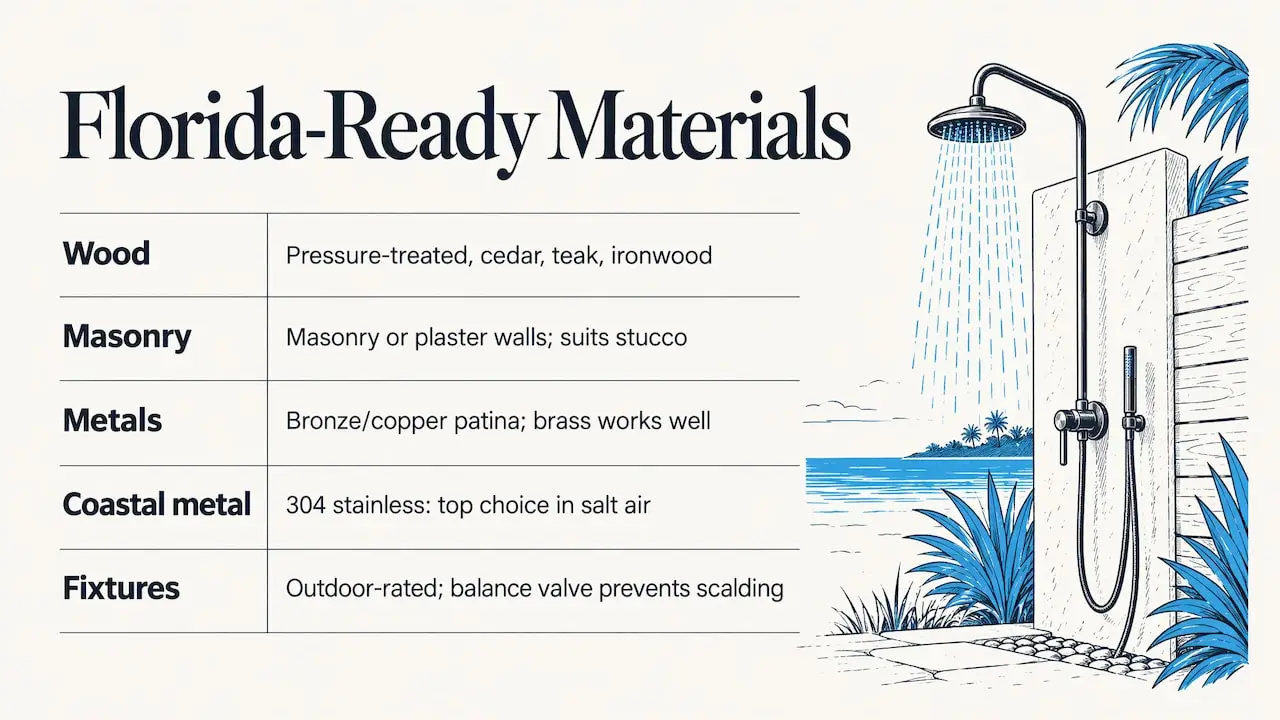
Wood. This Old House lists outdoor-suitable woods such as pressure-treated wood, cedar, teak or Brazilian ironwood, and notes that wood may need periodic treatment against mildew and fading.
Masonry and plaster. Sunset reports that outdoor showers can use masonry or plaster for walls. On a Florida home with stucco, this is a natural fit, and it pairs well with pool tile. If you want waterline-style accents, see our pool tile selection in St. Johns.
Metals. This Old House says bronze and copper develop patina, brass works well, and 304 stainless steel is a top choice in salty coastal air. However, 316 marine-grade stainless steel generally provides greater corrosion resistance in highly exposed coastal environments. That matters in Daytona Beach, Palm Coast and other Florida coastal communities. Sunset also highlights copper for its durability and distinctive appearance.
Do you need a special fixture? Not necessarily, but choose fixtures rated for outdoor installation and compatible with Florida’s humid conditions. A pressure-balance valve can help reduce sudden temperature changes in hot-and-cold showers, as recommended by This Old House plumbing and heating expert Richard Trethewey. For coastal properties, consider corrosion-resistant fixtures and confirm that valves, connections and exposed plumbing meet applicable installation requirements.
Flooring and Drainage
The floor decides whether your shower stays pleasant or turns into a muddy puddle.
Flooring Choices
This Old House lists wood decking, bluestone, tumbled river rock and a slatted teak mat as options. Sunset’s designer recommends elevated redwood or cedar slat decking for drainage underfoot, and says a sloped, non-concave boulder surface can prevent pooling. For a pool-adjacent shower in Florida, textured pavers that match the deck keep the look consistent and the cost predictable.
Where the Water Goes
Shower runoff is concentrated, so it needs a plan. A plumbing contractor advises directing it away from the house foundation, using a gravel bed, sloping, or a buried-pipe dry well, subject to local requirements.
This Old House explains that impermeable shower floors need appropriate slopes and drainage, while local codes may require connection to a sanitary sewer. Drainage around the surrounding patio also matters. Dell Outdoor’s guide to patio drainage problems discusses grading, surface drains and other ways to manage water around hardscape areas. Although the guide focuses on New Jersey, these general patio drainage considerations can also be relevant when planning a Florida pool deck.
Soap and shampoo make this a graywater question. The EPA explains that a branched-drain system usually distributes graywater from showers and sinks. Whether you may use that approach in your county is a local decision. Ask your building or health department before you dig.
Plumbing, Electrical and Permit Checks
Outdoor shower installations may involve plumbing, drainage, electrical work and local permitting requirements. The International Plumbing Code (IPC) provides a model framework for plumbing systems, including water distribution, drainage and backflow protection. However, Florida follows its own adopted building codes, which include state-specific requirements.
The Florida Building Commission provides access to Florida building code information, while the Florida Department of Business and Professional Regulation (DBPR) offers additional guidance on applicable codes and regulations. Before installing an outdoor shower, homeowners should confirm local requirements for permits, drainage, backflow protection and electrical safety. Requirements may differ between a simple poolside rinse station and a permanent hot-and-cold shower enclosure.
Homeowners in Ocala, St. Johns County, Volusia County, Duval County and Tallahassee should consult their local building departments before construction. Have licensed plumbing and electrical professionals complete connections where required. Planning these details during pool construction or a backyard renovation can help avoid unnecessary changes to finished decking, landscaping and underground utilities.
Winterizing and Seasonal Care
Most of Central Florida rarely sees a hard freeze, but North Florida and inland areas get freezing nights. This Old House warns that trapped water can freeze and crack outdoor shower pipes, and recommends indoor shutoffs, downward-sloping pipes and an outdoor drain-down valve. Lowe’s says that in colder climates you turn off the supply, drain the pipes and store removable fixtures indoors, and covering the shower or adding heat tape on permanent structures also helps.
Where you only expect a few cold nights a year, a short checklist works: shut off the supply, open the valve, remove a non-frost-proof showerhead and leave the valve open until the cold passes.
For routine care, This Old House’s checklist covers washing fixtures with warm soapy water, cleaning stone or tile to prevent algae, inspecting drains, checking for leaks and treating wood enclosures annually. In Florida’s humid climate, do the algae and drain checks more often than once a year.
Our Perspective on Outdoor Showers
We build outdoor showers as part of the whole backyard, not as add-ons. The shower, the pool, the spa and the kitchen share a deck, a drainage plan and a look. When one in-house team handles all of it, the shower lands where it should instead of wherever a subcontractor left a pipe.
That is why we design in 3D first. You can walk the path from the pool to the shower on screen, see the privacy wall from the patio and move it before anything is poured. Changes are cheap in a drawing and expensive in concrete.
Our advice: decide how you will use the shower, plan the drain and supply lines during the pool build, and pick finishes that match your deck. A shower that feels like it was always part of the yard is the goal.
The Agua Pools Team
Plan an Outdoor Shower With Your Pool
If you are building a new pool or remodeling an existing one, an outdoor shower belongs in the plan from the start. Agua Pools designs and builds custom in-ground pools, spas and complete outdoor living spaces across North and Central Florida, with a collaborative 3D design process so you can see your shower, pool and patio before construction begins.

Look at our outdoor living services, browse the Florida pool gallery for finished examples, or start with custom pool design. Pairing a shower with a spa or water feature? See spas and water features. For a full yard plan, read our backyard makeover with pool guide.
Outdoor Shower Questions Homeowners Ask
What Is the Best Material for an Outdoor Shower?
There is no single best material. Cedar, teak and other outdoor-rated woods provide a natural look, while stone and masonry offer durable enclosure options. For fixtures in coastal Florida, 316 marine-grade stainless steel generally provides better corrosion resistance than 304 stainless steel. Suitable brass and copper fixtures are also options. Match the materials to your pool deck and home for a cohesive design.
What Do You Use for the Floor of an Outdoor Shower?
Common choices are bluestone, tumbled river rock, wood decking and a slatted teak mat. Whatever you pick, the floor must drain. Pitch solid floors away from the house, or set permeable pavers over a gravel base or dry well, as local rules allow.
Do You Need a Special Fixture for an Outdoor Shower?
You need fixtures made for outdoor use, and a pressure-balance valve is a good idea if you run hot water. Fully exposed plumbing in colder areas should be easy to drain. Your plumber can confirm what your local code requires.
How Do You Winterize an Outdoor Shower?
Shut off the supply, drain the lines, open the valve and remove a non-frost-proof showerhead. In Florida this is a short job needed only before the occasional freeze, mostly in North Florida and inland areas.
Ready to add an outdoor shower to your pool or backyard? Talk to Agua Pools about a custom design for your home in Ocala, St. Johns, Daytona Beach, Palm Coast, Tallahassee or anywhere across North and Central Florida.