
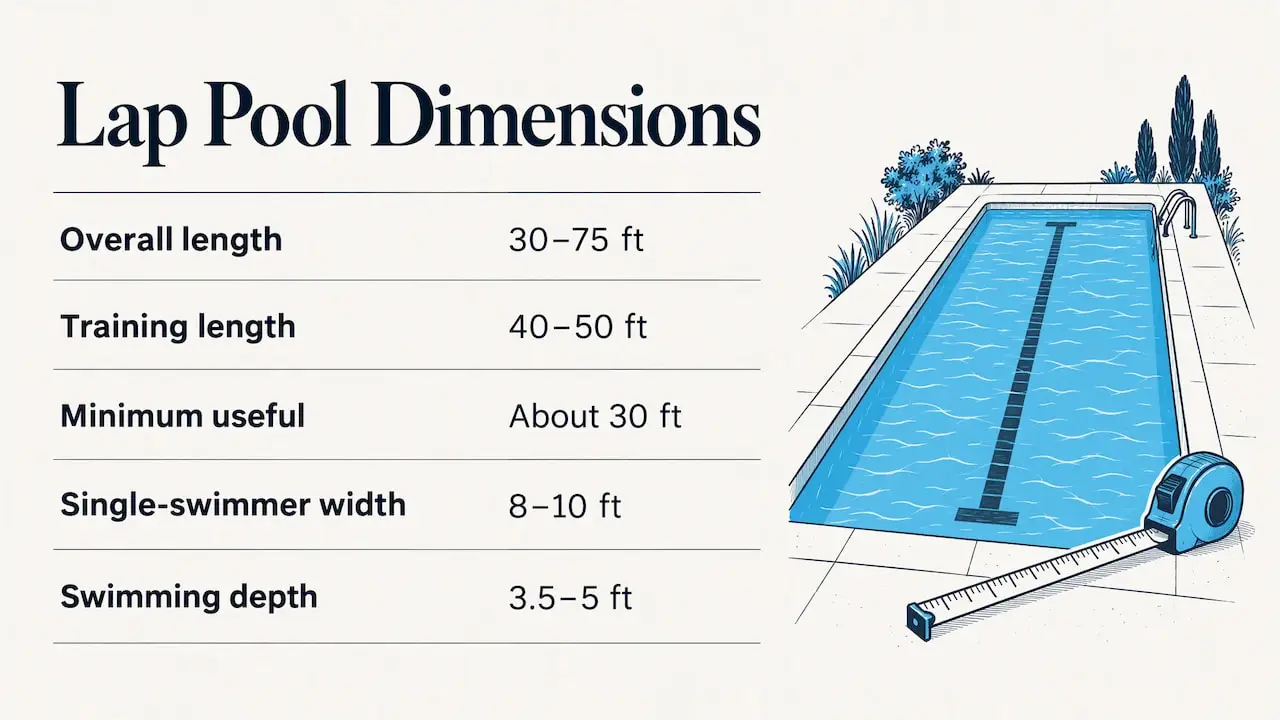
Most residential lap pools are 40 to 50 feet long, 8 to 10 feet wide and a consistent 3.5 to 5 feet deep. That range gives you enough room to swim real laps without turning every few strokes, and it fits on many suburban lots in Ocala, St. Johns County, Palm Coast and across North and Central Florida. Below, you will find how to pick a length, width and depth for your own yard, what shortens a pool’s usable swim lane, and when a smaller pool still makes sense.
Quick Answers: Lap Pool Dimensions
How long is a lap pool? Lap pools generally run from about 30 to 75 feet. For regular home training, 40 to 50 feet is the comfortable zone.
How wide is a lap pool? Eight to ten feet covers most single-swimmer pools. A standard example is 32 by 8 feet and about 5½ feet deep.
What is the minimum useful length? About 30 feet. Below that, you spend more time turning than swimming, and a counter-current unit becomes the better fit.
How deep should it be? A uniform 3.5 to 5 feet works for swimming and exercise. Deeper water is only needed if you plan to dive, which is a separate safety decision.
How Long Should a Lap Pool Be?
Length is the dimension that defines a lap pool, so start there. The longer the pool, the more strokes you take between walls and the closer your workout feels to open-water swimming.
Competition Lengths as a Benchmark
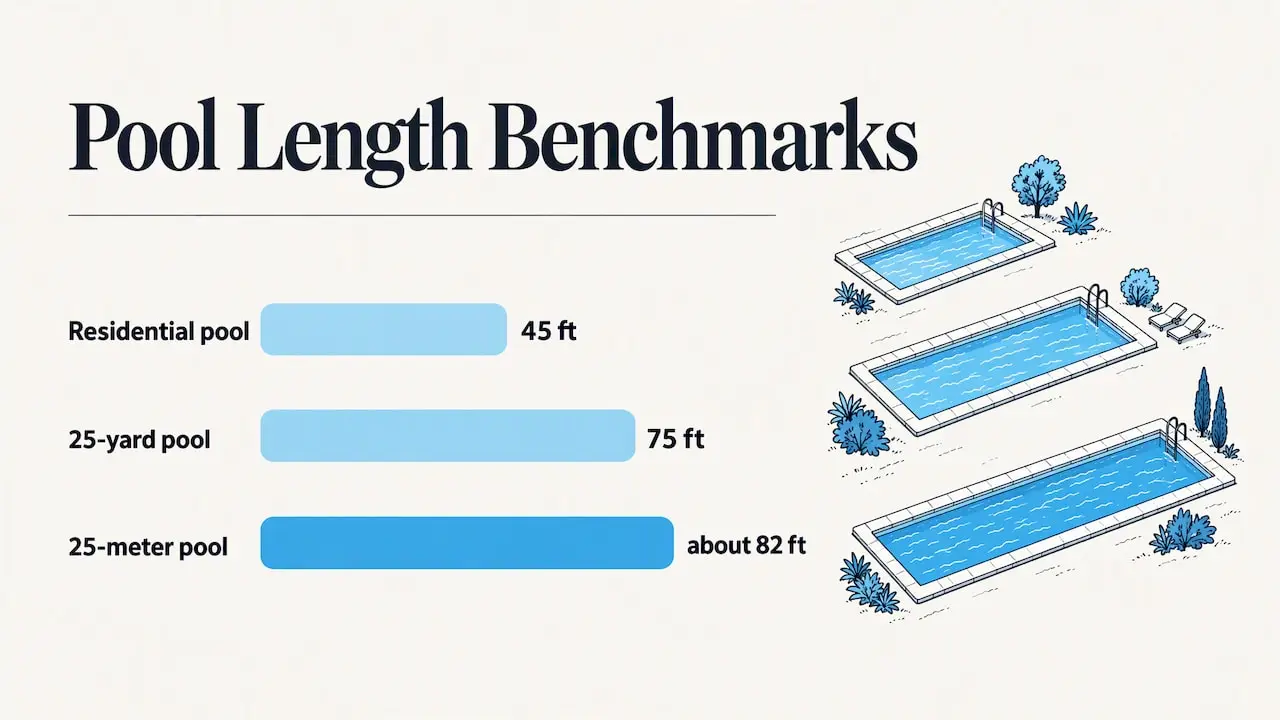
In the United States, a standard short-course competition pool is 25 yards long, and yards are used for many high school and college meets. For U.S. Masters Swimming, the minimum short-course-yards pool length is 25 yards, which equals 75 feet. A 25-meter pool is longer still, measuring approximately 82 feet, and is uncommon in residential settings.
You do not need to match those numbers. They are useful because they tell you how far a lap is in a standard pool, which helps you translate your fitness goals into your own yard. If you swim 1,000 yards for a workout in a 25-yard pool, you are making 40 lengths. In a 45-foot pool, the same distance takes about 67 lengths, so you will turn more often.
Realistic Home Lengths
For a home build, these are the practical bands:
-
30 to 35 feet: Workable for light exercise, rehab and short intervals. You will turn frequently.
-
40 to 50 feet: The sweet spot for most households. Long enough for rhythm, short enough for a typical Florida lot.
-
55 to 75 feet: Serious training length. It needs a long, relatively straight yard and a bigger budget for excavation, equipment and heating.
The Minimum Length for Real Laps
The minimum practical length for lap swimming is roughly 30 feet. At that size, you can swim, but turns come frequently, and many swimmers find the rhythm choppy. If your yard cannot accommodate 30 feet, a smaller pool equipped with a counter-current swimming system may provide an alternative for stationary swimming. The experience differs from swimming uninterrupted laps, but it can make a compact backyard more functional.
How Wide Should a Lap Pool Be?
Width is where homeowners often overspend. A lane is narrow by design.
Single Swimmer Width
Eight feet is a common minimum and a comfortable width for one person. It gives you room for arm recovery and a little drift without touching the wall. Many homeowners choose 8 to 10 feet, and the extra two feet can be useful for water aerobics, resistance work or simply feeling less boxed in.
Swimming With a Partner
If two people will swim at once, plan on a wider pool. For two swimmers side by side, 11 to 13 feet is a common recommendation. If you would rather circle-swim, where each person keeps to one side of a lane line, imaginary or real, a narrower pool can work, but you give up some personal space.
What Width Does to Your Costs
Width multiplies everything. A wider pool holds more water, which means more water to heat, a larger heat pump and a bigger cover. It also adds surface area for tile, coping and decking. Adding two feet of width to a 45-foot pool adds 90 square feet of surface, so decide on width deliberately rather than by default.
How Deep Should a Lap Pool Be?
Lap pools are usually shallower than traditional family pools. A consistent depth of 3.5 to 5 feet is a common residential planning range, although some lap pool designs extend to approximately 5½ feet. A uniform floor keeps the swimming lane consistent, without a slope or separate deep end.
Swimmers who flip turn usually prefer the deeper end of that range, while walkers, aquatic exercisers and rehab users like the shallower end because they can stand comfortably.
Diving Is a Separate Decision
A lap pool is built for swimming, not diving. The American Red Cross notes that most head, neck and spinal injuries in home pools result from diving into shallow water, and that a safe diving envelope, often requiring water 9 feet or deeper, must be verified by the diving board manufacturer before installation. For a typical lap pool, treat diving as off-limits and mark depths clearly. If you want a diving board, talk to your builder about a different pool design.
Lap Pool Sizes at a Glance
Use this table as a planning starting point. These are common residential ranges, not code requirements, and your site, soil and local permitting will shape the final numbers.
| Size (L x W) | Best for | Trade-offs |
|---|---|---|
| 30 x 8 ft | Light exercise, rehab, tight lots | Frequent turns |
| 40 x 8 ft | Daily fitness for one swimmer | Still a turn every few strokes for fast swimmers |
| 50 x 8 to 10 ft | Regular training, comfortable rhythm | Needs a long, narrow yard |
| 50 x 12 ft | Two swimmers side by side | More water to heat and cover |
| 75 x 10 ft | Serious training, competition-style yardage | Large footprint, highest cost |
The standard example of 32 by 8 feet falls between the first two rows, and above-ground versions can reach 75 feet long and 10 feet wide.
Measure the Swim Lane, Not the Footprint
Two pools with the same outside dimensions can swim very differently. The swimming axis should be measured inside face to face at the waterline, because cover rollers or projecting coping can significantly shorten the effective swim length.
Before you sign off on a plan, ask these questions:
-
Is the stated length measured wall to wall inside the water, or to the outer edge of the coping?
-
Where do the entry steps go? Steps placed in an alcove or niche keep the lane clear, as The Spruce notes about offset or niche wall areas.
-
Where will the automatic cover track or roller sit, and does it eat into the length?
-
Where do skimmers, returns and any swim jets sit relative to your lane?
A 45-foot pool with a 4-foot step intrusion is really a 41-foot pool. Spotting that on paper is far cheaper than discovering it after the shell is poured.
Choosing Dimensions for Your Yard, Goals and Budget
Work through these four factors in order. Each one narrows the range.
Start With the Lot
Length is capped by the longest straight run you can excavate while staying clear of setbacks, easements and utilities. Pool dimensions also interact with the deck around it. Plan for 4 to 8 feet of deck space around the pool for access and to keep debris out of the water. A 50-foot pool with 5-foot decks on the long sides and ends needs a space roughly 60 feet long and 18 or more feet wide, before you add a lanai or screen enclosure.
A four-sided isolation fence with self-latching gates is part of the layout too. The American Red Cross recommends it for home pools, so allow space for it. In Florida, check your county and city rules (Marion, St. Johns, Volusia or Duval, for example) for required barriers and setbacks before the design is final.
Match the Pool to How You Swim
-
Casual fitness, 2 to 4 times a week: 35 to 45 feet by 8 feet.
-
Regular training or triathlon prep: 45 to 60 feet by 8 to 10 feet.
-
Rehab, walking or low-impact exercise: 30 to 40 feet, shallower depth, wider if you want to move freely.
-
Family use alongside laps: consider a lap pool with a spa or a shallow sun shelf rather than adding width everywhere.
Count the Household
One swimmer needs 8 feet of width. Two swimmers at the same time need nearer 11 to 13 feet. If children will play in the pool, a narrow lap pool becomes crowded during a workout, so decide which job comes first.
Set the Budget Early
Surface area drives cost: excavation, steel, shell, tile, coping, decking, water and equipment all scale with it. Wider pools also need larger heating equipment and covers. A lap pool is often more economical than a large freeform pool because it uses a smaller footprint, but a 75-foot pool is a major project. Ask for a written scope that shows the cost of each size option so you can compare them directly.
Smaller Yards and Smarter Layouts
A narrow lot does not rule out swimming. Consider these approaches:
-
A compact lap pool at 30 to 35 feet with steps in a niche, so the entire length is swimmable.
-
An L-shaped or offset layout that tucks a spa or shallow lounge area into the corner and leaves a straight lane.
-
A counter-current unit in a short pool for stationary swimming.
-
A lap lane combined with a plunge area. Our guide to small backyard pool ideas for Florida homes shows how plunge and cocktail designs make a small footprint work harder.
A spa can also pair well with a lap pool. An integrated spa extends the pool’s enjoyment, and it gives you a place to warm up after cooler-weather swims.
Florida Considerations for Lap Pools
Florida’s long swim season is a strong reason to build a lap pool, but it affects design choices.
-
Heating: Even in Florida, mornings in North Florida winters can be cool. A heat pump or gas heater, plus a cover, can keep a long, shallow pool comfortable. Because water volume rises with width, size your equipment to the pool you are actually building.
-
Screen enclosures: A long, narrow pool needs a long enclosure. Build the enclosure dimensions into the plan from day one so posts and tracks do not intrude on the lane.
-
Lighting and automation: Early-morning and evening swimmers appreciate LED lighting and automated controls for heat, filtration and lights.
-
Stormwater and drainage: Long pools run across the lot, so the grading of your yard matters. A site visit shows where water will go.
Our pool equipment page lists the pumps, filters, heaters, heat pumps, lighting and automation categories we work with, so you can plan the equipment alongside the shell.
Our Perspective on Lap Pool Design
Most people choose a lap pool size by copying a number. We start from the swimmer. How often do you swim, who else will use the pool, and what do you want the yard to feel like when you are not swimming?
Our collaborative 3D pool design process exists for exactly this question. When you can see a 45-foot lane on your own lot, with the deck, screen enclosure and steps in place, you notice problems that a drawing might not reveal: a step that shortens the lane, a pergola that crowds the deck or a lane that points toward a neighbor’s window. Identifying these issues during the 3D design stage allows adjustments before construction begins, when changes are generally easier and less expensive.
We also believe in one in-house team from design through construction. A lap pool is unforgiving about measurements, and a few inches lost at the wall matter. When the same crew that designed your pool builds it, the dimensions you approved are the ones you get, and you hear from us at every phase.
The Agua Pools Team
Plan Your Lap Pool With Agua Pools
If you are ready to turn these dimensions into a plan, our custom pool design service starts with your lot, your swimming goals and a 3D preview, so you can see the length, width and depth before we break ground. When the design is settled, our new pool construction team builds it with our in-house crew rather than a chain of subcontractors.
Want to know how long the process takes? Our pool construction timeline for Florida walks through it stage by stage. You can also browse our Florida pool gallery for finished pools and outdoor living spaces, or read about backyard makeovers with a pool if your lap pool is part of a bigger plan.
Lap Pool Dimension Questions Homeowners Ask
Is a 30-Foot Pool Long Enough for Lap Swimming?
It is the practical minimum. You can swim laps and get a good workout, but you will turn often, which can interrupt your rhythm. If you can find another 10 to 15 feet, the swimming experience improves noticeably.
What Is the Most Common Lap Pool Width?
Eight to ten feet is the common range for a single-swimmer residential lap pool. Go to 11 to 13 feet only if two people will swim side by side regularly, because every extra foot adds water, heating load and surface area.
Do I Need a 25-Yard Pool to Train Seriously?
No. A 25-yard pool, which is 75 feet, is the U.S. competition standard, but most home swimmers train well in 40 to 50 feet. If you want to match competition yardage exactly, tell your designer early so the yard, enclosure and equipment are planned for it.
Can a Lap Pool Also Be a Family Pool?
Yes, with planning. A common approach is a 40 to 50 foot lap lane combined with a shallow shelf or an attached spa. That keeps the lane clear for swimming and gives the rest of the family a separate place to relax.
Build a Lap Pool in North and Central Florida
Whether you are in Ocala, St. Johns County, Daytona Beach, Palm Coast, Tallahassee or elsewhere in Marion, Volusia or Duval County, we can help you size a lap pool to your lot. Contact Agua Pools to start a design, or see our pages for a pool builder in Daytona Beach and a pool builder in Jacksonville.