
Good pool deck drainage comes down to three things: a deck that slopes away from the pool, drains at the low points or edges that catch the water, and a discharge route that carries it off your property without touching the pool plumbing. In Florida, the code minimum slope is 1/8 inch per foot, and many builders design for 1/4 inch per foot because of our heavy summer rain. This guide covers each part, so you can plan a new deck or diagnose an existing one.
Key Takeaways
- Slope: The Florida Building Code sets a minimum of 1/8 inch per foot, and 1/4 inch per foot performs better in heavy rain, according to StructureSmart Engineering.
- Drain type: Channel (trench) drains handle the most water along a deck edge. Point drains suit corners and curves.
- Discharge: Route deck water to a swale, dry well, or retention area. Never to the pool plumbing and never straight to the street.
- Warning signs: Puddles, slow draining, cracks, and staining near the deck point to a drainage problem worth fixing early.
- Timing: Drainage is cheapest to get right during design, before the deck is poured or laid.
Quick Answers: Pool Deck Drainage
What slope should a pool deck have? At least 1/8 inch per foot in Florida, and 1/4 inch per foot is a common design target for better runoff.
What are pool deck drains called? Channel drains, trench drains, strip drains, or linear drains for the long versions. Point drains or spot drains for the round or square grates.
Where should the water go? Away from the pool, house, and walkways, into a swale, dry well, or retention area on your lot.
Can you add drainage to an existing deck? Yes. Drains can be added to existing decks to supplement or replace a damaged drain, according to Slot Drain Systems.
Why Pool Deck Drainage Matters in Florida
A pool deck has to shed splash water, cleaning water, and rain. Florida adds a lot of the last one. A summer afternoon storm can drop an inch of water on your deck in minutes, and where that water goes decides whether your pool stays clean and your deck stays safe.
Pool deck drainage is designed to divert runoff from the surface around a pool. It protects the deck from erosion, protects people from slips and falls, and keeps rainwater from running into the pool, as Slot Drain Systems explains.
The cost of poor drainage shows up slowly. Standing water can grow algae, create a slip hazard, and discolor deck finishes, according to AQUA Magazine. Repeated wet and dry cycles lead to cracking, staining, and efflorescence on pavers, concrete, and stone, and water collecting at the base of the pool shell can add hydrostatic pressure that shifts decking, according to Vodaland USA.
How Pool Deck Drains Work
Every drainage system is the same idea in three steps. The deck surface is pitched so water moves toward a collection point. A drain grate or channel catches it. Underground pipe carries it to a discharge point.
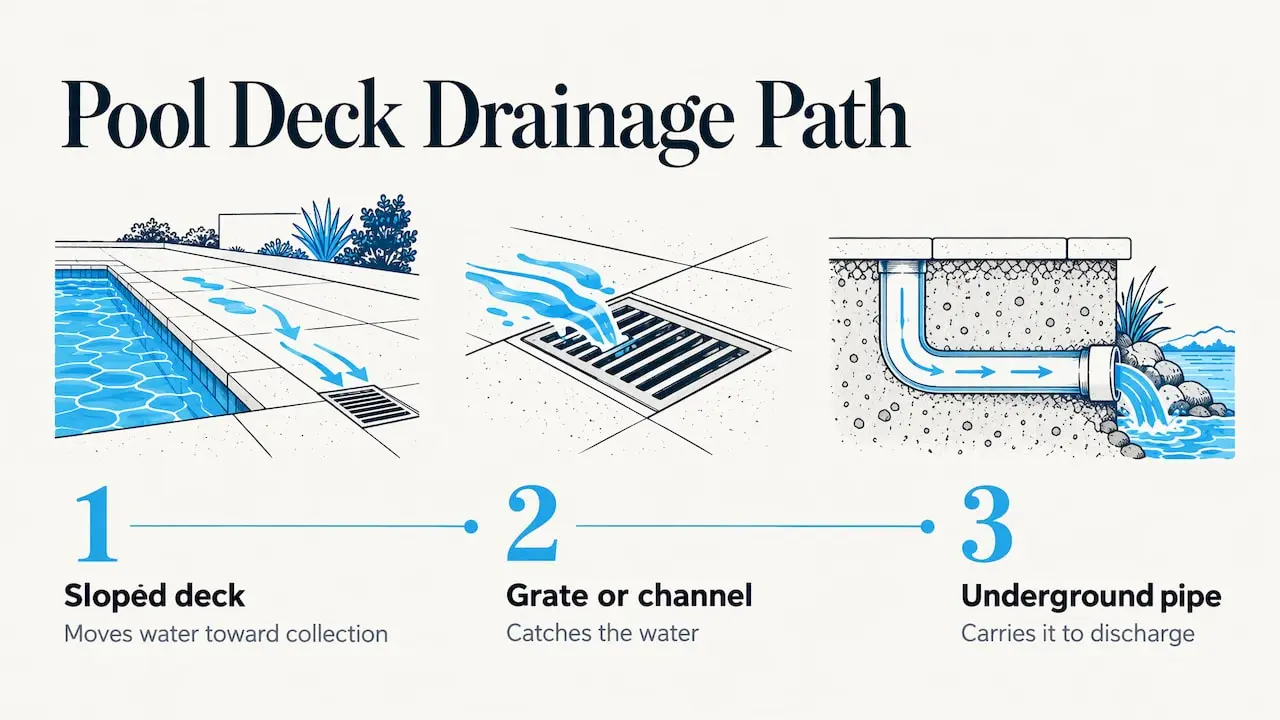
The pitch does most of the work. The drain only finishes the job. A flat deck with a beautiful channel drain will still puddle, because water has nowhere to travel.
Pool deck drains are typically installed along the pool coping, at the edges where the deck meets landscaping, and at any low spot where water collects. The goal is to intercept water before it reaches adjacent surfaces or flows back toward the pool. A continuous perimeter drain is ideal for new construction, according to Stormwater Drainage.
What Slope a Pool Deck Needs
The short answer is a gentle, consistent fall away from the pool. It should be steep enough to move water but flat enough to walk on comfortably.
Florida Minimums and Practical Targets
The Florida Building Code requires a minimum pool deck slope of 1/8 inch per foot, roughly 1 percent. StructureSmart typically recommends 1/4 inch per foot, roughly 2 percent, for better performance during Florida’s heavy rain events.
For a sense of how the finish changes the number, AQUA Magazine’s Steve Swanson notes that a 1/4 inch per foot pitch is standard for exposed aggregate, while smoother finishes such as broom or soft stamp finishes can go as shallow as 1/8 or 3/16 inch per foot. Drain spacing depends on deck width: every 6 to 8 feet on a 3-foot skirt deck, and every 10 feet on a 5-foot band (AQUA Magazine).
How Other States Write the Rule
If you read about slope online, you will see different numbers because states write different rules, and many apply to public pools. These are examples, not Florida requirements for your backyard:
| State | Rule | Source |
|---|---|---|
| California | Deck slope of at least 1 percent (1/8 inch per foot) and no more than 2 percent (1/4 inch per foot) away from the pool | UpCodes |
| Georgia | Decks sloped to drain, with no more than 1/8 inch of standing water 20 minutes after water stops being added | Georgia pool code |
| Wisconsin | Standing water no deeper than 1/8 inch after 20 minutes; exterior decks sloped a maximum of 1/2 inch per foot | Wisconsin code |
| Arizona | Minimum 1/4 inch per foot and maximum 1 inch per foot for public and semipublic pools | Arizona code |
| Massachusetts | 1/4 inch per foot for exposed aggregate; 1/8 inch per foot for textured concrete, pavers, and wood or composite | Massachusetts code |
The common thread is the 1/8 inch rule of thumb for standing water: after the water stops, the surface should dry out quickly rather than hold a film. Your local building department and your pool contractor confirm what applies to your address.
Slope by Surface Material
Texture matters. A rougher surface, like exposed aggregate, holds more water on its face and needs more fall. Smooth stamped concrete sheds water more easily at a shallower pitch. Pavers and natural stone, such as travertine, rely on a well-compacted base and consistent joints so the fall does not telegraph into dips. If you are choosing a surface, our travertine and marble comparison for pool decks covers how each material behaves outdoors, and our guide to cool deck options for Florida pools covers which surfaces stay comfortable underfoot.
Types of Pool Deck Drains
The main options are channel drains (trench drains), point drains (spot drains), slot drains, and French drains, according to StructureSmart.
Channel Drains
Channel drains are long, narrow grates covering a trench, installed flush with the deck. They are the most common pool deck solution and usually run along the perimeter where the deck meets the landscape. A 4-inch-wide channel is typically adequate for residential pool decks in South Florida, while larger decks may need 6-inch or wider channels (StructureSmart).
Their big advantage is geometry. A linear drain collects along its full length, so the deck needs only one direction of fall toward it. That makes paving simpler and the fall more consistent (Strip Drains Sydney).
One installation note from Concrete Decor: channel drains should not double as expansion joints, because concrete slabs can pinch, slip, or shear them (Concrete Decor).
Point Drains
Point drains are individual grates set at low spots. They handle less flow than a channel, which makes them a good fit for small enclosed areas and interior corners. They also solve difficult spots, like peninsulas inset into a pool or free-form radius walls, where a straight channel will not fit (Concrete Decor).
The tradeoff is grading. A point drain needs the surrounding surface to slope in from several directions, and on a pool surround with paving running different ways, that can mean complex grading and uneven spots that still hold water (Strip Drains Sydney).
French Drains and Catch Basins
A French drain is a gravel-filled trench with a perforated pipe. It works beside the deck, in the yard, collecting water that comes off the surface or off the surrounding lawn. A catch basin funnels water away from the pool and yard, and for very large yards a professional can connect the system to a drain field away from the property, according to Frank Wall.
Which Drain Fits Which Deck
| Situation | Best fit |
|---|---|
| Rectangular deck meeting lawn or landscape | Perimeter channel drain |
| Interior corner or small enclosed patio | Point drain |
| Free-form pool with tight curves | Point drains, plus a channel on straight runs |
| Long run of channel | Channel with periodic down adapters to underground piping |
| Wet yard beside the deck | French drain or catch basin |
For long channel runs, periodic down adapters to underground plumbing help move water out faster, according to Concrete Decor.
Material and Grate Details That Matter Near a Pool
A few specifics separate a drain that lasts from one that fails. Engineers advise avoiding ferrous metals near saltwater, using 316 stainless steel in coastal or saline applications, and confirming that grate openings meet heel-proof (6 mm or less) and slip-resistance standards. The system should also connect to the site drainage line with a debris trap or catch basin (Trenchdrain Co.).
That matters in Florida, where many pools run salt systems and many homes sit near the coast, from Daytona Beach to the St. Johns County shoreline. Salt air and splash both attack cheap metal.
Where the Water Should Go
A drain is only as good as its destination. In Florida, deck water should be routed to a swale, dry well, or retention area, not directly to the pool or the street. Most jurisdictions require on-site stormwater management for residential lots, and drainage pipes must stay completely separate from pool plumbing to prevent cross-connections (StructureSmart).
Pipe Sizing and Connections
Drains connect to standard 2-inch, 3-inch, or 4-inch PVC through outlet adapters. Common discharge options include landscape drain fields, dry wells, connection to the property drainage system, or, where permitted, storm drains (Stormwater Drainage). As a rough guide, 4-inch pipe typically serves one or two channel drains, and 6-inch pipe suits larger systems (StructureSmart).
Georgia’s code adds a useful principle: no direct connection between deck drains and the sanitary or storm sewer (Georgia pool code). Whatever your county permits, keep deck water out of the sanitary sewer, and confirm discharge rules with your local permitting office.
Keep Water Away From the House
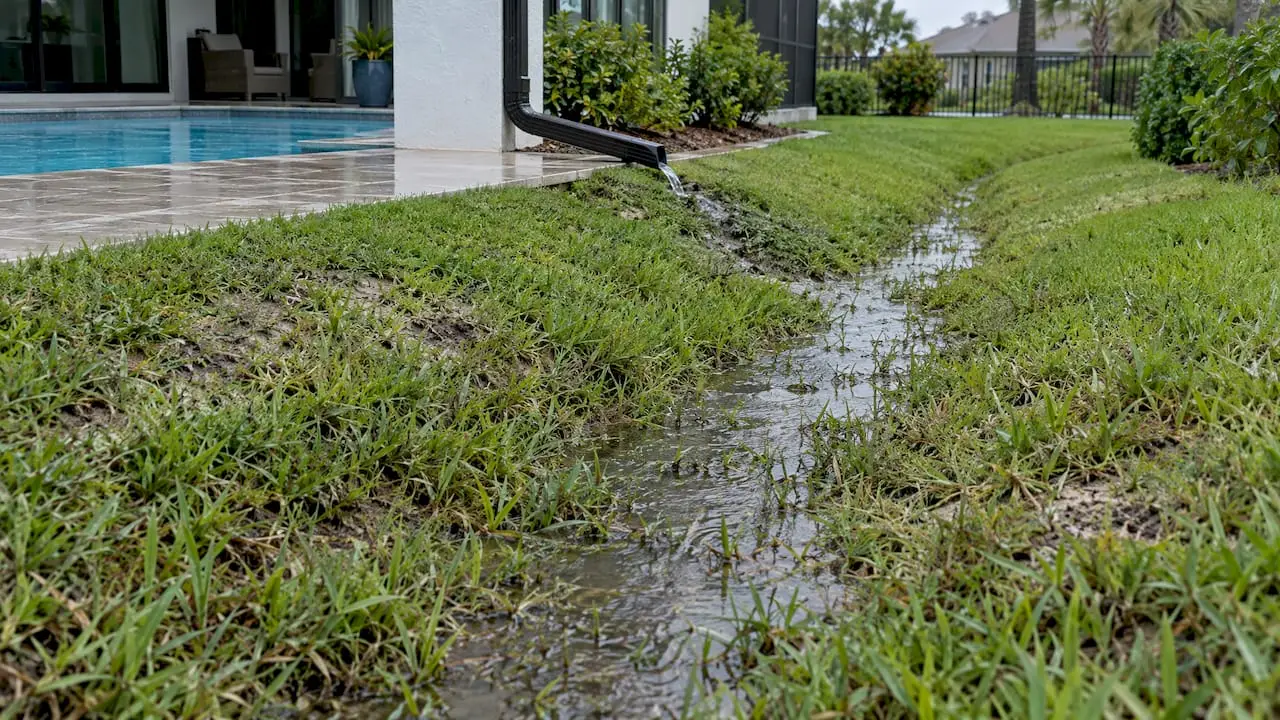
Water should always run away from the pool deck and never toward the patio, yard, house, or walkway (Frank Wall). On sandy North and Central Florida lots, a dry well or swale usually drains quickly. On a lot with a higher water table or heavier soil, retention and grading become more important, and a site plan is the right place to settle it.
Common Causes of Poor Drainage
Three causes show up again and again, according to StructureSmart:
- Settling: The soil under the deck compacts or washes out, leaving low spots where puddles form.
- Coping-level issues: The deck edge sits wrong at the pool, so water is directed toward the pool instead of away.
- Landscape higher than the deck edge: Soil, mulch, or sod piled against the deck sends yard runoff onto it.
Signs to watch for: slow draining, water pooling, foul odors, visible blockages, and cracks near the deck (Triad Associates). A simple check after a rain shows you a lot. Walk the deck 20 minutes after the water stops and note where a film of water remains.
Fixing Drainage on an Existing Pool Deck
Start with the cheap steps and work up.
- Clear the grates. Debris blocks drains quickly, and clearing grates weekly is a simple habit that prevents most backups (StructureSmart).
- Check the landscape. Lower any soil or mulch that has built up against the deck edge so it sits below the surface.
- Map the puddles. Mark low spots with chalk after a rain. Patterns show whether you have a settling problem or a grade problem.
- Add drainage. Drains can be installed on existing decks to add capacity or replace a damaged unit (Slot Drain Systems). A channel drain cut into the slab at the problem edge is the usual approach.
- Correct settled sections. If part of the deck has sunk, concrete leveling and lifting can restore the surface so water can drain again, though a heavily settled deck may call for a rebuild of that section.
- Rebuild when the slope is wrong across the deck. If the whole surface is flat or pitched toward the pool, a remodel is the lasting fix.
If water has been sitting against the house or in an enclosure for a while, check for moisture damage. A mold and water damage inspection in Deltona is the type of service to call when dampness has reached a structure.
Our Perspective on Pool Deck Drainage
We see drainage as a design decision, not a repair. The best time to solve a puddle is on the 3D design before anyone digs. When we model a backyard with a homeowner, we can see where the deck falls, where the lawn sits relative to the coping, and where the water will go in a July storm.
That is also why we build with one in-house team. Drainage touches excavation, plumbing, concrete or paver work, and landscaping. When those trades hand off between separate subcontractors, the slope and the drain location can get lost between them. When one crew owns the whole job, the grading plan carried from design to the last paver is the same plan.
After building more than 1,000 pools across North and Central Florida, our advice is simple: decide the drain type, the discharge route, and the deck finish together, early. A textured finish, a free-form shape, or a deck that meets a raised planter each changes the drainage plan, and it is far easier to adjust on paper than in cured concrete.
Planning Drainage With Your Pool Design
Drainage works best when it is part of the first conversation about the pool, not a punch-list item. Our custom pool design process uses collaborative 3D previews so you can see the deck layout and surrounding yard before construction begins, and our team stays in contact with you through every phase.

If you are building new, our new pool construction service covers the deck, the drains, and the outdoor living features around the pool. If your existing deck puddles, cracks, or slopes the wrong way, pool remodeling is where we rework surfaces, drainage, and layout. We build for homeowners in Ocala, Daytona Beach, Tallahassee, Palm Coast, and across Marion, St. Johns, Volusia, and Duval counties. To see how we sequence a project, read our pool construction timeline for Florida.
Questions Homeowners Ask About Pool Deck Drainage
What Are the Best Drains for a Pool Deck?
For most rectangular residential decks, a perimeter channel drain is the best choice because it collects water along its whole length and needs only one direction of slope. Point drains are better for interior corners and curved edges. Many decks use both.
How Far Should Water Be Routed From the Pool?
No single distance applies to every lot. The rule is directional: water should run away from the pool, house, and walkways, and reach a swale, dry well, or retention area, per StructureSmart. Your site plan and local permitting office set the specifics for your property.
Can I Add Drainage to a Pool Deck I Already Have?
Yes. Drains can be added to an existing deck to increase capacity or replace a damaged one. The work usually involves cutting a trench in the slab, setting the channel, and piping it to a discharge point. A pool contractor can confirm the right location after seeing where water collects.
Is a Flat Pool Deck Ever Acceptable?
Not for a deck that gets rain. Codes across states point to the same standard: decks should be sloped to drain and should not hold standing water for long after the water stops. In Florida the minimum slope is 1/8 inch per foot (StructureSmart).
Why Does My Pool Deck Hold Water After Rain?
The usual causes are settled soil that created a low spot, a deck edge pitched toward the pool, or yard soil sitting higher than the deck. A clogged drain grate is the quickest thing to rule out first.
Sources And Code References for Pool Deck Drainage
- StructureSmart Engineering: Pool Deck Drainage
- Slot Drain Systems: Pool Deck Drainage 101
- AQUA Magazine: Basic Drainage
- Vodaland USA: Improve Drainage Around Your Swimming Pool
- Stormwater Drainage: Pool Deck Drainage Solutions
- UpCodes: Pool Decks
- Georgia pool code, R. 511-3-5-.06
- Wisconsin code, SPS 390.13
- Arizona code, R18-5-217
- Concrete Decor: Channel Drains and Point Drains Around Pools
- Strip Drains Sydney: Pool Drainage Guide
- Frank Wall: Pool Deck Drainage Systems
- Trenchdrain Co.: Pool Trench Drains
- Triad Associates: Pool Deck Drainage Systems
- USA Spray Me: Concrete Leveling
- Ready 2 Inspect: Mold and Water Damage in Deltona
Planning a new pool or fixing a deck that floods in Ocala, Daytona Beach, Tallahassee, Palm Coast, or anywhere in North and Central Florida? Talk to Agua Pools about a design that handles the water before the first shovel hits the ground.