
The most popular pool designs for Florida homes right now are clean-lined geometric and modern pools, relaxed freeform or lagoon shapes, tropical looks built around greenery, and compact plunge pools for smaller lots. The features that make them work in this climate are a shallow tanning ledge, an integrated spa, soft lighting, a slip-resistant deck and a layout that handles heavy rain. Below is how each style and feature fits a Florida yard, what space it needs and how to decide.
Quick Answers to Pool Design Ideas in Florida
-
Geometric and modern pools suit rectangular lots and contemporary homes, while freeform pools suit irregular yards and a resort feel.
-
A tanning ledge and an integrated spa add the most day-to-day use for Florida families.
-
Plan drainage, deck surfaces and safety barriers at the design stage, not after the pool shape is set.
-
Small yards can still fit a pool if swimming, lounging and dining zones are planned on purpose.
-
Exact costs depend on site, size and finishes, so ask for a written estimate based on your own lot.
Pool Styles That Work in Florida
Florida backyards range from narrow lots in Jacksonville subdivisions to wide acreage in Marion County, so no single shape wins. This table compares the styles homeowners ask us about most. It describes design fit, not pricing.
| Style | Best For | Florida Considerations | Space Needed |
|---|---|---|---|
| Modern | Contemporary homes, clean lines | Light deck colors stay cooler underfoot; simple lines pair well with screen enclosures | Medium to large |
| Geometric | Rectangular or square yards | Straight edges make covers, fencing and enclosures simpler to plan | Small to large |
| Freeform or lagoon | Irregular lots, natural settings | Curves blend with landscaping; rain runoff needs careful grading | Medium to large |
| Tropical | Homes surrounded by greenery | Needs plants chosen for Florida heat, plus leaf and debris planning | Medium to large |
| Plunge or small yard | Compact lots, townhomes | Works best with zoned lounging and a tall screen or privacy planting | Small |
Modern and Geometric Pools
Modern pools lean on straight edges, crisp tile lines and minimal decoration. Geometric pools add variety through angles, steps and offset sections. A Central Florida builder quoted in Orlando Magazine reported that geometric pools with varied angles have gained popularity and are more likely to withstand the test of time than trend-driven shapes. That fits what we see: a pool that echoes the lines of the house tends to age well.
Geometric layouts also make practical planning easier. Straight edges simplify fence placement, enclosure framing and decking. If your home has square rooflines, large windows, or a black-and-white palette, a modern rectangle with a raised wall or spill edge is a natural match.
Freeform and Lagoon Pools
Freeform pools use flowing curves that contour to your yard. The same Orlando Magazine piece notes that freeform and lagoon-style pools retain a following. They suit homeowners who want the pool to feel like part of the landscape, especially near wooded lots in St. Johns County or along the Ormond Beach and Palm Coast corridor, where mature trees and natural planting frame the view.
The tradeoff is planning detail. Curved shapes need careful layout so decking, steps and the water line meet cleanly. A 3D design preview helps here, because you can see how the curves sit against the house before anything is excavated.
Tropical Pools
Tropical is less a shape than a mood: a beach entry or broad shallow ledge, a waterfall or rock feature, layered plants and warm lighting at night. It fits Florida naturally. The planting palette matters more than the pool outline. Choose plants that tolerate heat, salt-free or salty irrigation conditions on your lot, and that do not drop heavy debris into the water. A landscape professional who knows your county helps here.
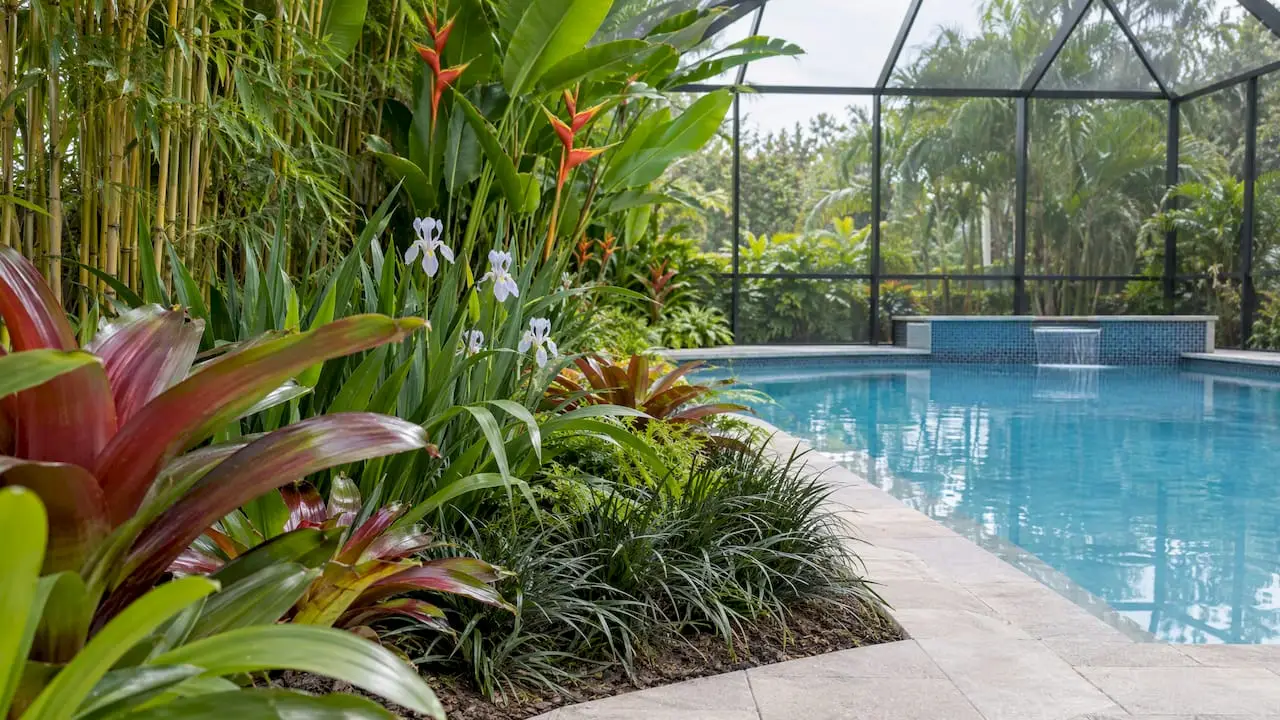
For inspiration on how planting, privacy and pool zones combine, the landscape case study in Sarasota Magazine paired a pool cage with bromeliads, mondo grass, irises, heliconia and bamboo screening. That mix shows how tropical texture can sit right at the pool edge.
Small Backyard Pools
A small yard does not rule out a pool. The same Sarasota case study included a landscape architect’s compact design where swimming, shallow lounging, exercise, screening and outdoor living were deliberately zoned rather than squeezed together. That is the principle behind every good small-yard pool: decide what each square foot does.
Plunge pools, cocktail pools and narrow lap-style shapes are the usual options. Our guide to small backyard pool ideas for Florida homes covers plunge, cocktail and freeform designs in more detail.
Features Worth Designing In
Tanning Ledges
A tanning ledge, also called a sun shelf, is a broad shallow area usually near the steps. AQUA Magazine reports typical depths of 4 to 18 inches and notes that the shallow water is warmer and can hold furniture or bubblers, depending on the design. The same discussion makes a useful point: a ledge is not just decoration. Its depth, footprint, location and finish affect comfort, circulation, maintenance and how different family members use the pool.
In practice, that means placing the ledge where little ones can play within reach of adults, and where afternoon sun or screen shade suits how your family uses it.
Integrated Spas
A spa can sit flush with the pool or be raised so it spills over into it. Spillover spas typically share water with the swimming pool, while separately plumbed spas can allow independent temperature control. For Florida homeowners, this distinction matters because a separately heated spa can provide warm-water relaxation without heating the entire swimming pool.
Our spas and water features team can walk you through which layout suits your lot.
Waterfalls and Water Features
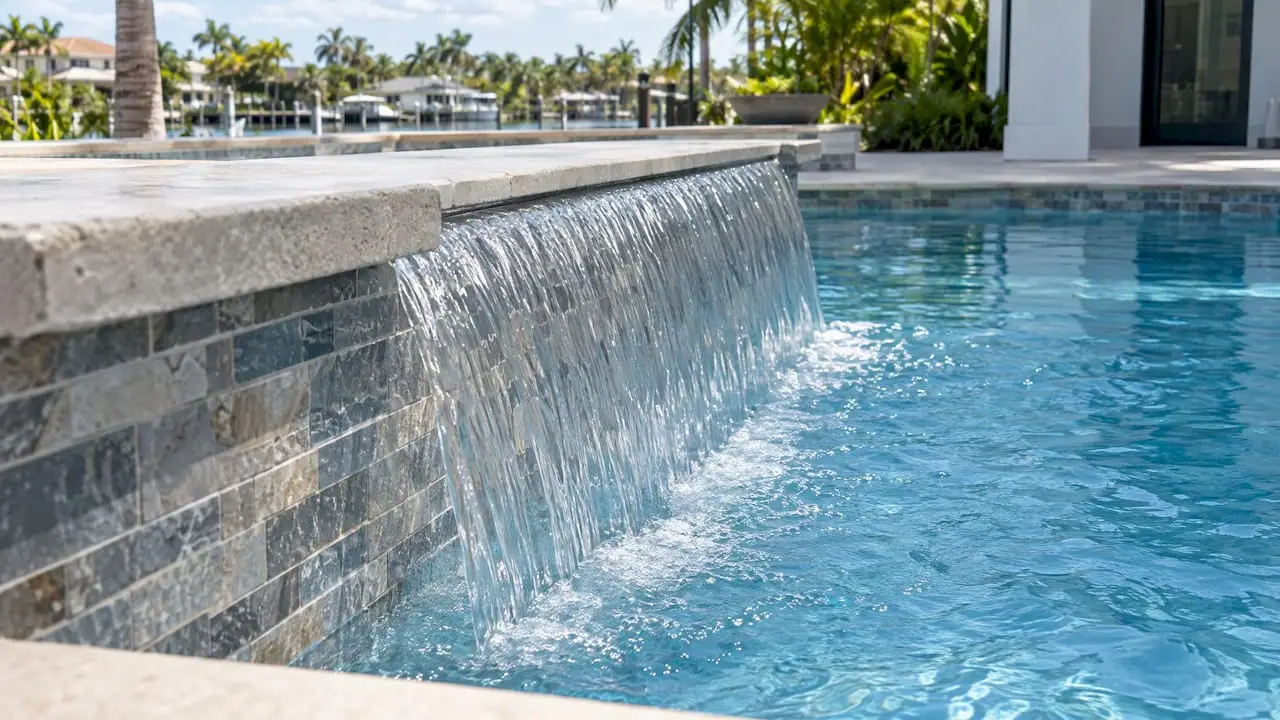
Waterfalls, scuppers and sheer descents add sound and movement, and they mask road or neighbor noise. Stone-faced waterfalls lean tropical. A thin sheet of water off a raised wall leans modern. Because moving water adds equipment and plumbing, decide early whether you want one, so the pump sizing and wall construction are planned from the start.
Lighting and Automation
LED pool lighting extends the pool into the evening, which matters in a state where summer afternoons are hot and nights are the comfortable hours. Color-changing fixtures suit entertaining, and warm white suits a quiet tropical look. Pair lighting with automation so you can control lights, heaters, features and pumps from a phone. Ask about this at the design stage so conduit and equipment placement are done once.
Decking and Hard Surfaces
Deck material shapes comfort more than most people expect. Light-colored pavers and textured surfaces tend to feel better underfoot in full sun, and non-slip finishes matter around wet areas. Florida Department of Health inspection guidance, laid out in its code reference document, says pool decks should be free of standing water and obstructions, step edges should have contrasting slip-resistant markings, and handrails must be provided for pool steps. Those points apply to public pools, but they are sensible targets for a home pool too.
Layout, Privacy, and Outdoor Living
A pool rarely stands alone. The best Florida backyards connect the water to a shaded sitting area, a kitchen or grill and some planting that offers privacy. A few layout rules help:
-
Start with sightlines. Stand at your back door and at the kitchen window. The pool should look good from where you spend time indoors.
-
Zone the yard. Give swimming, lounging, dining and cooking their own areas, even in a small space.
-
Plan privacy early. Tall screens, pool cages, bamboo or layered hedges can block neighbor views. The Sarasota case study above used a tall cage and bamboo screening for this reason.
-
Place shade deliberately. A pergola or covered lanai near the ledge or spa makes midday use realistic.
-
Leave service access. Equipment needs room, and so do mowers and cleaners.
If you want a full-yard approach, our backyard makeover with pool planning guide walks through how to sequence the pool, patio and extras. Our outdoor living services cover pergolas, fire features, putting greens and outdoor kitchens, and our pool screen enclosures page explains how a cage shapes both bugs and privacy.
Florida Climate, Drainage, and Storms
Heavy summer rain, a high water table in some areas and hurricane season all influence design. Three points matter most.
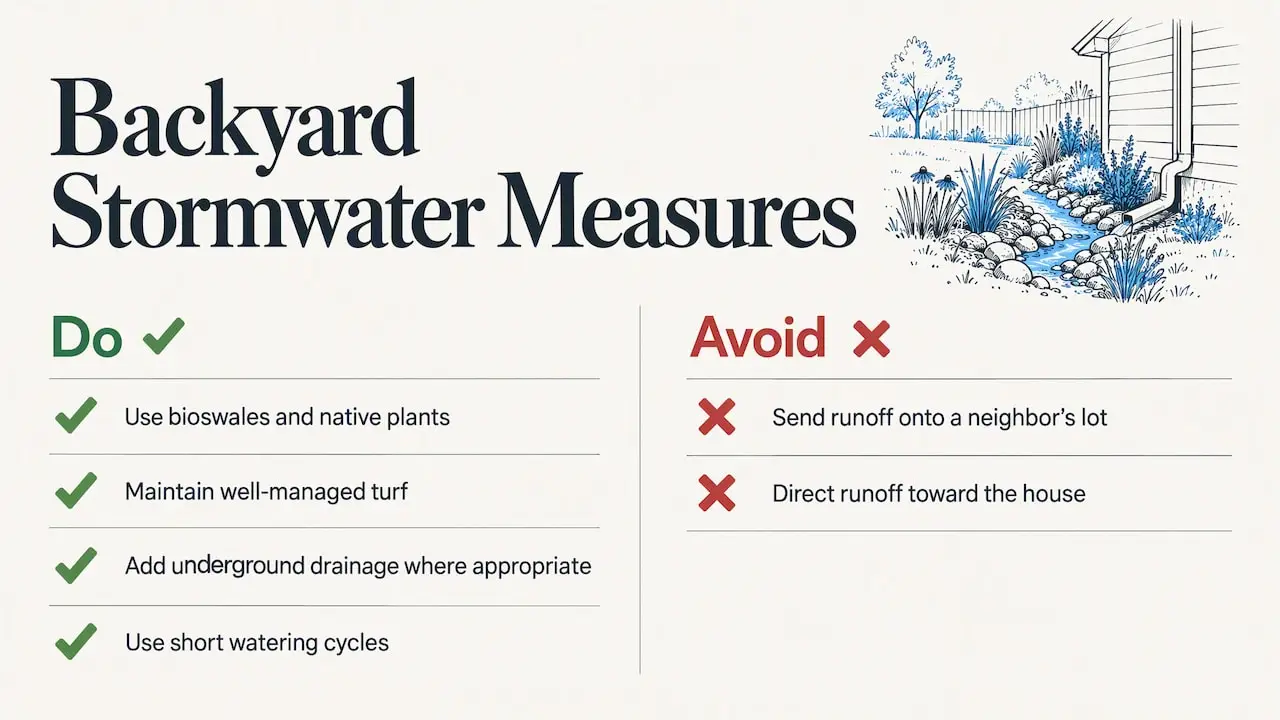
Drainage. FEMA’s hurricane and flood handbook for parks and recreation sites recommends drainage measures such as bioswales and culverts, native plants, well-managed turf, underground drainage where appropriate and short watering cycles. The guidance is written for larger sites, but the ideas scale down to a backyard: direct runoff away from the house and avoid sending it onto a neighbor’s lot.
Local rules. Stormwater criteria vary by city. Sarasota, for example, uses 10-, 25- and 100-year, 24-hour storm events as design storms in its stormwater design chapter. Your own city or county sets its own standards, so pool grading and drainage should be checked against local rules. Permit packages also tend to be document-heavy: Miami Beach’s residential pool permit checklist asks for site, structural, electrical, mechanical, landscaping and plumbing documents as applicable, with setbacks, property lines, grades, the pool, deck, walkways, equipment and fences on the site plan. Expect something similar in Marion, Volusia, Flagler, St. Johns, Duval and Leon counties, and confirm the exact requirements with your local building department.
Storm readiness. UF/IFAS Extension advises against draining a residential pool before a storm, because saturated soil around it can make draining raise the risk of cracking, plumbing, electrical and deck damage. Its pools and hurricanes guidance says to keep the pool full, let overflow move away from the home through properly engineered decking, and keep circulation running while power remains. That is a design point: your deck slope and overflow path should be planned so excess water leaves the house side.
Safety Built Into the Design
Safety belongs in the layout, not on a later checklist. The Florida Department of Health says home swimming pools are where most children are likely to drown. Its Marion County office recommends layers of protection: active adult supervision, four-sided fencing, self-closing and self-latching gates, safety covers and alarm systems, and preparedness such as a nearby phone and CPR and first-aid knowledge.
When you place a tanning ledge, spa or gate, think about where a child could enter the water unseen. For dimensions, gate hardware and code, read our guide to pool fence requirements in Florida.
Customization, Space, and Budget
Space. Small pools can fit on compact lots when the plan is tight, and larger freeform or lagoon designs need room for curves, decking and planting. Measure setbacks, easements and utility lines before you fall in love with a shape. They decide what is possible on your lot.
Customization. Every layer is adjustable: shape, depth, steps, ledge, spa, water features, tile, lighting, decking and enclosure. A 3D design preview lets you see those choices together before construction, which is why we build it into the process.
Budget. Cost depends on size, access, soil conditions, finishes and the extras you add, so any universal number would mislead you. For a local view, our inground pool cost guide for Daytona Beach explains what drives the price, and our pool construction timeline shows how the build unfolds stage by stage. Our seasonal pool specials page lists current offers.
Design a Pool With Agua Pools
We design and build custom in-ground pools, spas and outdoor living spaces for homeowners across North and Central Florida. Our process starts with a collaborative 3D design, so you can walk through the shape, ledge, spa and decking before we break ground.
Our in-house team handles the project from design to finish, which is meant to keep timelines from slipping on subcontractor schedules. Explore custom pool design or new pool construction, and browse the Florida pool gallery for ideas. Already own a pool? Our pool remodeling service can bring an older shape and surface up to date.
Our Perspective on Florida Pool Design
We have built more than 1,000 pools, and the best ones share a habit: the design starts with how the family lives, not with a catalog shape.
A Florida pool is used in heat, in rain and at night. That is why we plan shade, lighting, drainage and safety barriers together with the water itself. A tanning ledge that nobody can stand to sit on in July, or a deck that floods after a storm, is a design miss, not bad luck.
We prefer to show you the result before we build it. Our 3D design process lets you adjust the spa position, ledge depth and lighting while changes are still easy. Because our own team handles each phase, the plan you approve is the plan that gets built, and you hear from us at every step.
Whether you want a modern rectangle, a lagoon-style freeform or a tight plunge pool, the right answer is the one that fits your lot, your home and your routine.
The Agua Pools Team
Practical Recommendations
-
Match the pool to the house. Straight-lined homes pair with modern or geometric pools. Homes with rounded landscaping often pair with freeform pools.
-
Add a ledge before you add extras. It broadens who uses the pool every day.
-
Decide on a spa early. Spillover and separate-water layouts change the plumbing and the footprint.
-
Choose cool, grippy decking. Test samples in the sun at your own home.
-
Plan grading with the pool. Send runoff away from the house and check local stormwater rules.
-
Bring in shade and privacy. Pergolas, screens and plants make the pool comfortable for more hours of the day.
-
Build safety in. Fences, gates, alarms and covers should be part of the first drawing.
Where We Build Across Florida
We work with homeowners in Ocala and Marion County, Daytona Beach and Ormond Beach in Volusia County, Palm Coast in Flagler County, St. Johns and St. Augustine in St. Johns County, Jacksonville in Duval County and Tallahassee in Leon County. Local soil, tree cover and permitting differ in each place, so we plan every pool around the specific lot. If you are near the coast, see our Daytona Beach pool builder page. If you are in the northeast, see our Jacksonville pool builders page.
Florida Pool Design Questions
What Pool Shape Is Best for a Florida Backyard?
The best shape is the one that fits your lot and home. Geometric and modern shapes suit rectangular yards and contemporary houses, while freeform shapes suit irregular or wooded lots. A Central Florida builder quoted by Orlando Magazine considers geometric pools more likely to stand the test of time.
Can I Fit a Pool in a Small Florida Yard?
Often, yes. Plunge, cocktail and narrow designs can work when the yard is zoned for swimming, lounging and dining. Setbacks and easements set the limit, so measure these first and have a designer review your lot.
How Deep Should a Tanning Ledge Be?
AQUA Magazine reports typical tanning shelf depths of 4 to 18 inches. Choose the depth by how you will use it: shallow for loungers and young children under supervision, a bit deeper for sitting.
Should I Drain My Pool Before a Hurricane?
UF/IFAS Extension advises against it. Saturated soil can make an empty pool more likely to crack or damage plumbing, electrical and decking. Keep it full and let your engineered deck drainage carry overflow away from the house.
What Safety Features Should Be Part of the Design?
The Florida Department of Health recommends four-sided fencing, self-closing and self-latching gates, safety covers, alarms and constant adult supervision. Include these in your plan from the beginning, and confirm local code with your building department.
Ready to design your pool in Ocala, Daytona Beach, Ormond Beach, Palm Coast, St. Augustine, Jacksonville or Tallahassee? Request a custom pool estimate from Agua Pools and see your backyard in 3D before we build.