
Poolside Fire Pit Planning Quick Answer: Gas fire bowls, fire pits and fire tables can complement a Florida swimming pool when the location, materials, clearances and fuel connections are properly planned. Natural gas and propane are popular poolside options because they produce no wood ash or flying embers. The best design depends on the pool layout, surrounding structures, available seating space and applicable safety requirements.
Agua Pools designs custom pool fire features for homeowners throughout North and Central Florida. Whether you want a raised fire bowl, a gathering area beside the pool or an integrated fire-and-water feature, planning during the pool design or remodeling stage can simplify construction and help coordinate the finished outdoor space.
Poolside fire pit, fire bowl, fire table or fireplace
Fire features come in several styles, each suited to a different poolside layout. Irrigation & Lighting discusses how fire pits, bowls, tables and outdoor fireplaces contribute to outdoor living designs, including the growing use of gas-powered features.
Here is how that plays out beside a pool:
| Format | Best For | Poolside Considerations |
|---|---|---|
| Fire Bowl | Decorative flames and poolside accents | Often installed on a raised wall or pedestal and planned as part of the pool design. |
| Fire Pit | Social seating and conversation areas | Requires adequate space for seating, safe clearances and an appropriate non-combustible surface. |
| Fire Table | Casual seating, drinks and entertaining | Available in different heights and styles; suitable for approved outdoor patio locations. |
| Fireplace | Larger outdoor living areas | Requires additional structural planning, appropriate ventilation and safe clearances. |
| Fire-and-Water Feature | Decorative focal points combining flame and flowing water | Requires coordinated planning for water circulation, gas connections, electrical components and pool construction. |
Fire pits and tables work well for conversation areas because seating can be arranged around the flame. Incorporating built-in seating walls, coordinated patio materials and outdoor lighting can further enhance the gathering space. These outdoor fire feature design ideas illustrate how fire pits, pools and patios can work together to create a cohesive outdoor living environment. The right choice depends on available deck space, seating preferences and the pool’s overall design.
Let the pool’s shape pick the fire feature
Pool shape can help guide fire feature selection. As discussed in PoolMagazine.com’s article on pairing fire features with pool geometry, square and rectangular fire bowls often complement geometric pools, while round bowls can work well with freeform designs. Matching shapes helps create a coordinated appearance without making the fire feature compete with the pool.
A few pairings that work in Florida backyards:
-
Rectangular pool with clean coping: a linear or square bowl on a low wall at the shallow end, lined up with the pool’s edge so the flame reads as part of the architecture.
-
Freeform lagoon-style pool: a round fire pit on a paver pad set back from the water, with curved seating that follows the pool’s outline.
-
Plunge or cocktail pool in a small yard: one compact fire bowl or a fire table rather than a full seating circle. Our guide to small backyard pool ideas for Florida homes shows how much a compact layout can hold.
-
Pool with a raised spa: a bowl on the spa wall, where the flame reflects in the water. This is the classic resort look, and it is built into the structure.
Before you commit, browse our pool gallery and our overview of pool design ideas for Florida homes to see how fire sits next to different shapes.
Gas or wood by the pool
For a poolside fire pit gas fire features are often a practical choice near swimming pools because they do not produce the flying embers, wood ash or smoke associated with wood-burning fires. Natural gas and propane models also offer convenient ignition and flame control. Irrigation & Lighting discusses gas fire feature options and how heat output varies among designs. The appropriate size and output depend on the product, surrounding space and intended use.
Natural gas versus propane comes down to your property:
-
Natural gas: a permanent line from your supply, no tanks to refill. Best when a gas line already serves the house, a pool heater or an outdoor kitchen.
-
Propane: a tank, which suits properties without a natural gas line, a common situation on larger rural lots in Marion County and around Ocala.
If your pool will also have a gas heater or an outdoor kitchen, a single gas plan covering all of them is cleaner than adding lines one at a time. That is one reason we like to scope fire features together with the rest of the outdoor living spaces.
A wood-burning pit is the most portable format, since a bowl on legs needs no gas connection, but it brings the smoke and ember issues above. Inside a screen enclosure those issues are sharper still: sparks and heat can damage mesh and frame, and ash is a water-quality problem as much as a cleanup one. For screened lanais and pool enclosures, any proposed fire feature must be evaluated against the manufacturer’s instructions, overhead clearances, ventilation requirements and applicable local codes. Do not assume a gas feature is safe simply because it produces no wood embers.
Materials that last in Florida’s salt, sun and humidity
Florida’s humidity, sun and coastal conditions can influence fire feature material selection. PoolMagazine.com discusses corrosion-resistant options, including powder-coated finishes and marine-grade stainless steel, for outdoor fire feature applications. Material suitability also depends on exposure, maintenance and the manufacturer’s specifications.
The surrounding patio should also be considered when selecting a fire feature. Concrete, stone and suitable outdoor pavers are common poolside materials, but heat resistance and slip resistance depend on the specific product and installation. For homeowners comparing patio finishes, Northern Lights Design’s guide to outdoor patio tile explains considerations for selecting porcelain and other outdoor surfaces. Around a pool, prioritize a finish suitable for wet-foot traffic.
Clearances and surfaces: the numbers that matter
Clearance is the most misunderstood part of a poolside fire feature because it is not one number. Here are the ones to know.
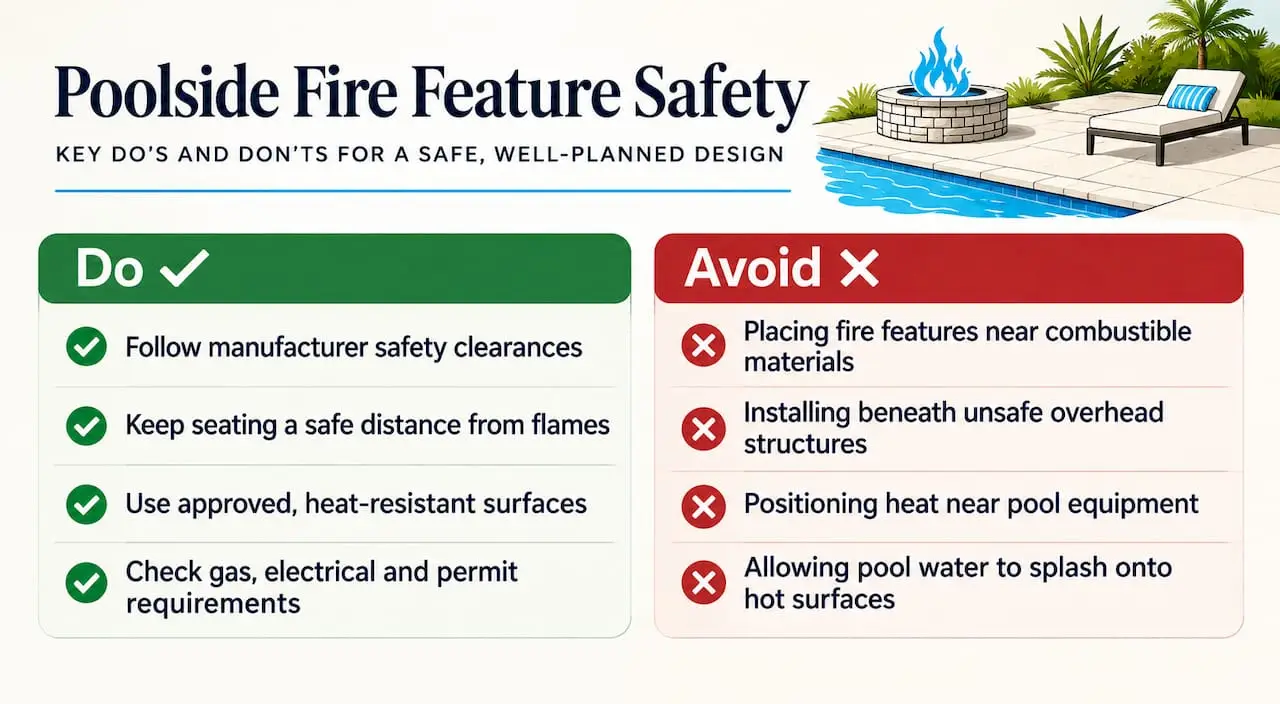
Freestanding fire pits and bowls. The National Fire Protection Association (NFPA) recommends keeping outdoor fires away from combustible materials, structures, vegetation and overhead hazards. Its fire pit safety guidance discusses a 10-foot separation from combustible surroundings. However, specific installation requirements depend on the type of fire feature, manufacturer instructions and local regulations.
Homeowners should also consider property insurance requirements. Higginbotham’s guide to fire pit safety and homeowners insurance discusses how fire features can affect property safety and insurance considerations.
Gas features built for the purpose. A listed, permanently installed gas feature is governed by its manufacturer’s installation instructions and your local code, and the stricter of the two controls. Do not default to the smallest number you can find online.
Seating. Arrange chairs and other furniture outside the fire feature’s required clearance area, allowing comfortable circulation between the pool, seating and surrounding structures. Follow the manufacturer’s minimum distances from combustible furniture and materials.
Overhead. Open sky is best. A pergola, roof overhang or oak limb above the flame changes the equation, and so does a screen enclosure. Ask your designer to check the height of every structure above the fire before the location is fixed.
Equipment. Place the fire where embers and heat will not reach pumps, filters, covers or the pool’s automation equipment, and where splash from swimmers does not hit a hot rim.
Fire features should be installed on surfaces approved for the specific appliance and its heat output. Concrete, stone and suitable pavers may be appropriate, while wood decking, composite materials and other combustible surfaces require particular caution. Some products permit installation with approved protective systems, but others prohibit it. Always follow the manufacturer’s installation requirements.
The electrical and gas rules most homeowners do not hear about
This is where a poolside fire feature differs from one in an ordinary backyard. Water changes the rules.
-
GFCI protection and bonding. Electrical equipment and conductive components installed near swimming pools may be subject to special grounding, bonding and GFCI protection requirements under Article 680 of the National Electrical Code. Metal fire features and nearby electrical components should be evaluated as part of the overall pool electrical design. The Florida Electrical Authority’s overview of pool and spa electrical requirements provides additional background, although the applicable code and installation requirements should be confirmed with a qualified Florida electrical professional.
-
Gas connections. Permanently installed natural gas and propane fire features must comply with applicable Florida fuel gas requirements, local permitting rules and manufacturer installation instructions. Proper gas supply sizing, shutoff valves, appliance listing and safe installation should be reviewed by an appropriately licensed professional. Florida’s building code requirements can be researched through the Florida Building Code Information System.
-
Insurance. Before installing a permanent fire feature, ask your homeowners insurance provider whether the addition affects coverage or requires documentation. Higginbotham’s fire pit safety guide offers additional considerations.
A fire-and-water feature may require coordination among pool construction, gas installation, electrical work and masonry. Planning these elements together helps establish safe equipment locations, proper connections and a construction sequence that minimizes unnecessary changes after the pool deck is finished.
Decide before the pool is built
Built-in fire bowls, raised fire features and fire-and-water combinations are best considered during pool design. Planning ahead allows the builder to account for structural support, gas lines, electrical connections and surrounding deck materials. Adding these features to an existing pool may also be possible during remodeling, depending on the available space and construction requirements.
A useful planning order:
-
Pick the role. Is the fire an accent on the water, a gathering spot or a dining table?
-
Match the shape to the pool’s geometry, as above.
-
Choose the fuel and confirm your gas supply.
-
Mark clearances on the plan: structures, trees, screen enclosure, equipment, seating.
-
Choose materials for salt, sun and wet feet.
-
Confirm permits for gas, electrical and any structure.
-
Plan lighting and controls. Coordinate pool lighting, equipment automation and any compatible fire feature controls during design.
Plan your fire feature with Agua Pools
Agua Pools designs custom swimming pools, spas, fire features and outdoor living spaces throughout North and Central Florida. Our 3D design process helps homeowners visualize how fire bowls, seating, pool lighting and surrounding features will work together before construction begins.
Explore our custom pool design services for new construction or pool remodeling options for an existing backyard.
Frequently asked questions
How far should a fire pit be from a pool?
There is no universal distance that applies to every fire feature beside a swimming pool. Placement depends on the appliance, combustible materials, surrounding structures and local requirements. NFPA recommends keeping recreational fires at least 10 feet from combustible surroundings, while listed gas fire features must follow their specific installation instructions. A qualified installer should confirm the final location.
Is a gas or wood fire pit better by a pool?
Gas is the better fit for most pool decks. It lights and shuts off instantly, makes no smoke or sparks and leaves no ash to blow into the water. Wood offers portability and crackle, but it brings embers, smoke and local burn rules, and it is not advised inside a screen enclosure.
Can I put a fire pit on my pool deck or patio?
Possibly. Concrete, stone and certain paver surfaces may be suitable, depending on the fire feature’s installation requirements. The location must also provide appropriate clearances from combustible materials, seating, structures and overhead features. Permanent gas installations may require permits and professional installation.
Do I need a permit for a poolside fire feature?
Usually, yes, for anything permanently connected to gas or wired near the pool. Gas connections and pool-area electrical work, including GFCI protection and bonding, are regulated, and your city or county building department sets the exact requirements. A builder who handles the pool can coordinate them with the build.
If you are planning a pool or a fire feature in Ocala, Marion County, St. Johns County, Daytona Beach, Volusia County, Palm Coast, Duval County, Tallahassee or anywhere across North and Central Florida, contact Agua Pools to start your design.