
A pool loan vs. HELOC comparison comes down to financing costs, payment flexibility, and whether you want to use your home as collateral. A pool loan typically provides a lump sum with fixed monthly payments, while a home equity line of credit (HELOC) allows homeowners to borrow as needed, usually at a variable interest rate. For Florida homeowners planning a new swimming pool, a fixed-rate pool loan may offer greater payment predictability, while a HELOC may provide flexibility for construction expenses paid in stages.
Before choosing pool financing in Florida, compare interest rates, loan terms, fees, repayment schedules, and the risks associated with borrowing against your home. Agua Pools helps homeowners throughout North and Central Florida plan custom swimming pool projects with clear designs and construction estimates that can support financing decisions.
Pool Loan vs. HELOC: Quick Comparison
| Feature | Pool Loan | HELOC |
|---|---|---|
| Loan type | Typically unsecured personal loan | Secured by home equity |
| Interest rate | Usually fixed | Usually variable |
| Funds | Lump sum | Draw as needed |
| Monthly payments | Generally predictable | May change |
| Collateral | Usually none | Your home |
| Best suited for | Defined project budgets | Flexible construction spending |
| Main consideration | Interest rate and loan terms | Variable payments and home equity risk |
Neither financing option is automatically better. The right choice depends on your project budget, available equity, lender terms, and comfort with changing payments.
What is a Pool Loan
A pool loan is financing used to pay for swimming pool construction, installation, or related outdoor improvements. Many pool loans are unsecured personal loans that provide a fixed amount with scheduled monthly payments. However, some pool financing programs use secured loans, so homeowners should confirm the terms before applying.
An unsecured pool loan generally does not require home equity or place a lien on the property. This can appeal to homeowners who want predictable payments without using their house as collateral. Interest rates, borrowing limits, repayment periods, and fees depend on the lender and the borrower’s qualifications.
According to the Consumer Financial Protection Bureau (CFPB), home equity loans and HELOCs use a property as collateral, making them different from unsecured personal loans.
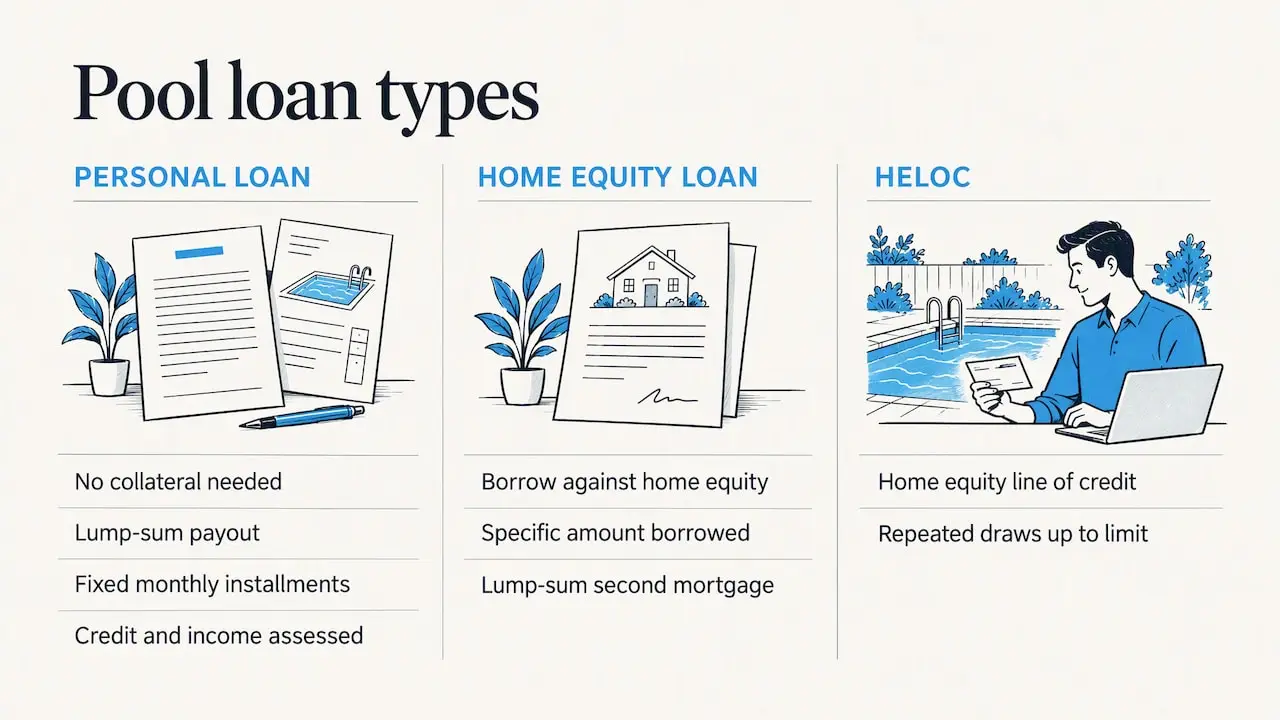
A home equity loan is a different animal. The CFPB describes it as a specific amount borrowed against the equity in your home. It is a lump-sum second mortgage. A HELOC, by contrast, is a line of credit you can draw on repeatedly up to a limit.
How a HELOC Works During a Pool Build
A HELOC for pool construction typically has two phases: a draw period and a repayment period. During the draw period, homeowners can borrow funds as needed and may make interest-only payments. Once the draw period ends, borrowing stops and repayment of the outstanding balance begins.
According to the Federal Trade Commission (FTC), repayment terms vary by lender. Some HELOCs offer a 10-year draw period followed by a longer repayment period. Homeowners should review their lender’s specific terms before using a HELOC to finance a swimming pool.
The Variable Interest Rate
The Consumer Financial Protection Bureau (CFPB) explains that variable HELOC rates generally consist of a financial index plus the lender’s margin. As the index changes, the interest rate and monthly payments may increase or decrease.
Before applying, compare introductory rates, adjustment schedules, rate caps, minimum withdrawals, and annual fees.
The Payment Reset
One important consideration with a HELOC is the potential increase in monthly payments when the draw period ends and principal repayment begins.
For example, assume a homeowner borrows $100,000 at a hypothetical 7.34% annual interest rate:
-
Interest-only payment: Approximately $612 per month.
-
Principal and interest over 15 years: Approximately $918 per month.
This represents an increase of approximately 50%, assuming the interest rate remains unchanged. These figures are for illustration only and do not represent current lender rates or financing offers.
Homeowners should request a written payment illustration showing the expected monthly payment after the draw period and how payments could change if interest rates increase.
HELOC Freezes and Credit Reductions
A lender may freeze or reduce a HELOC under certain circumstances, including a significant decline in property value or concerns about the borrower’s ability to repay, as explained by the FTC.
For homeowners financing a swimming pool, this could affect access to funds during construction. Maintaining a separate contingency budget helps reduce reliance on an unused credit line if unexpected expenses arise.
When Is a Pool Loan Better Than a HELOC?
A pool loan may be better than a HELOC when homeowners want fixed monthly payments, have a clearly defined construction budget, or prefer not to borrow against their property.
A pool loan may be appropriate when:
-
The swimming pool design and construction price are established.
-
Predictable monthly payments are a priority.
-
Home equity is limited or unavailable.
-
The homeowner prefers an unsecured financing option.
-
The loan amount and repayment terms fit the household budget.
The primary disadvantage is that unsecured loans may have higher interest rates or shorter repayment periods than home equity financing.
When Does a HELOC Make More Sense for Pool Construction?
A HELOC for pool construction may be appropriate when homeowners have sufficient equity and want access to funds throughout the building process rather than receiving the entire amount upfront.
Potential advantages include borrowing only what is needed, drawing funds as construction progresses, and financing additional improvements such as a spa, pool deck, or outdoor kitchen.
However, most HELOCs have variable interest rates, and payments can increase when rates rise or the repayment period begins. Because the home secures the loan, failure to repay can result in foreclosure.
The Federal Trade Commission (FTC) explains these risks and recommends carefully reviewing the loan’s repayment terms, fees, and interest rate adjustments.
Is a Home Equity Loan Another Option for Pool Financing?
A home equity loan for a pool is secured by your property, like a HELOC, but generally provides a lump sum with a fixed interest rate and scheduled monthly payments. It may appeal to homeowners with sufficient equity who want predictable payments without a variable-rate credit line.
Unlike a HELOC, interest generally begins accruing on the full amount disbursed. Because the home serves as collateral, missed payments can put the property at risk. Loan eligibility, borrowing limits, and fees vary by lender.
Compare the Total Cost, Not the Advertised Rate
The CFPB warns in its HELOC booklet that a HELOC’s APR may reflect interest only and may not include closing costs or other charges. A low-looking HELOC rate is therefore not automatically cheaper. The FTC adds that lenders must disclose the APR, payment differences between the draw and repayment periods, variable-rate terms, and charges such as opening, maintenance, transaction, appraisal, credit-report and attorney fees.
Compare each offer on this list:
-
APR plus origination or closing fees
-
Appraisal, recording and attorney charges
-
Annual or transaction fees on a HELOC
-
Minimum draw amounts
-
Prepayment terms
-
Index, margin, adjustment frequency and lifetime cap
-
Whether a HELOC balance can be converted to a fixed rate
-
The payment after the draw period, at the maximum rate
Then compare over the time you expect to keep the debt. A fee that looks small on a 15-year loan can matter a lot if you plan to pay off in three years, and a rate that looks great can lose its edge once fees are added.
What About the Tax Deduction?
Many pool buyers hear that HELOC interest is deductible. Sometimes it can be, but not automatically. According to IRS Publication 936, home equity loan or HELOC interest is potentially deductible only when the debt is secured by your main or second home, you itemize on Schedule A, and the proceeds are used to buy, build or substantially improve that home. Interest on home equity debt used for personal expenses after 2017 is not deductible. The same publication describes dollar limits on qualified mortgage debt, including the generally applicable $750,000 limit ($375,000 if married filing separately) for newer acquisition debt.
In plain terms, a pool is not deductible just because it is a pool. Whether it counts as a substantial improvement to your residence, and whether itemizing even makes sense for you given the standard deduction, is a question for a CPA or enrolled agent. Do not build a projected tax benefit into your financing decision until that professional has reviewed your situation.
If you do borrow against your home, keep the signed contract, change orders, invoices, permit costs and payment records. They help show where the money went and keep improvement spending separate from personal spending, as the IRS publication’s framework suggests.
Qualifying: What Lenders Look For
There is no single pass-or-fail pool loan rule. The CFPB explains that qualification is lender-specific. Home equity borrowing requires enough equity and underwriting of income, debts, credit, property value and your ability to repay. An unsecured pool loan generally avoids a lien but may give you less borrowing capacity or a higher rate.
Before you apply, get the full scope of your project in writing. That means the pool, spa, screen enclosure, decking, drainage, electrical, permits, landscaping and a contingency. If you finance only the pool and discover later that the enclosure and decking were separate, you will be back at the lender’s desk. Your credit score, debt-to-income ratio and equity are the three numbers to check first.
Planning Pool Financing Around Your Florida Construction Project
When comparing pool loans vs. HELOCs in Florida, homeowners should consider the full construction budget rather than focusing only on the advertised interest rate. A custom swimming pool project may include excavation, plumbing, electrical work, interior finishes, decking, landscaping, and optional outdoor living features.
For homeowners in Ocala, Daytona Beach, Tallahassee, Palm Coast, St. Johns, and surrounding North and Central Florida communities, project costs can vary depending on property conditions, pool dimensions, design features, and local construction requirements.
Agua Pools’ 3D pool design process helps homeowners visualize their swimming pool and outdoor living features before construction begins. Establishing a detailed project scope and reviewing the construction payment schedule can make it easier to compare financing options with a lender.
Questions to Ask Before You Sign
Bring these to any lender, whichever product you choose:
-
Is this loan secured by my home? What happens if I miss payments?
-
What is the full APR, including every fee?
-
For a HELOC: what are the index, margin, cap and adjustment schedule?
-
How long is the draw period, and what will my payment be after it ends?
-
Can you show me a written payment illustration at the maximum rate?
-
Can part of the balance be converted to a fixed rate?
-
Are there annual fees, minimum draws or prepayment penalties?
-
Under what conditions can you freeze or reduce my line?
-
How are funds released: to me, or to the contractor in stages?
The FTC also advises reading the closing papers and comparing the disclosed fees, payment terms and variable-rate provisions before you sign. Take the time. A few days of comparison on a six-figure decision is cheap.
FAQ
Is it hard to qualify for a pool loan?
It depends on the lender. Unsecured pool loans rely mostly on your credit, income and existing debts, while home equity products also need enough equity and a property valuation. There is no single pass-or-fail standard, so getting quotes from a few lenders shows what you actually qualify for.
Is a HELOC tax deductible?
Possibly, but not automatically. Under IRS Publication 936, the debt must be secured by your main or second home, you must itemize, and the money must be used to buy, build or substantially improve that home. Ask a CPA or enrolled agent whether a pool qualifies in your case before you count on it.
What is better, a HELOC or a home equity loan?
Choose a home equity loan if your project price is fixed and you want one lump sum and a predictable payment. Choose a HELOC if spending will come in stages or the scope may change. A HELOC usually carries a variable rate, while a home equity loan may be fixed or adjustable depending on the product.
How is interest calculated on a HELOC compared with a pool loan?
On a HELOC, interest accrues on the amount you have actually borrowed, not the unused limit. On a lump-sum loan, interest accrues on the full amount disbursed from the start. A HELOC rate is usually an index plus the lender’s margin, so your payment can change when the index moves.
Can I use a HELOC as my only backup if costs run over?
It is risky. A lender can freeze or reduce a HELOC if your home’s value drops significantly or it believes you may be unable to repay. Build a cash contingency into your budget rather than relying on an undrawn line.
Related Pool Planning Resources in Florida
-
Pool and Outdoor Living Financing in North and Central Florida
-
10 Steps to Choosing the Right Pool Contractor in Ocala, Florida
Plan Your Florida Pool Project With Agua Pools
Agua Pools provides custom swimming pool design and construction services throughout North and Central Florida. Explore our pool financing options, use the pool loan calculator to estimate payments, or learn more about our custom pool design services.
Ready to plan your new swimming pool? Request a custom pool estimate and take the next step toward creating your Florida backyard retreat.